
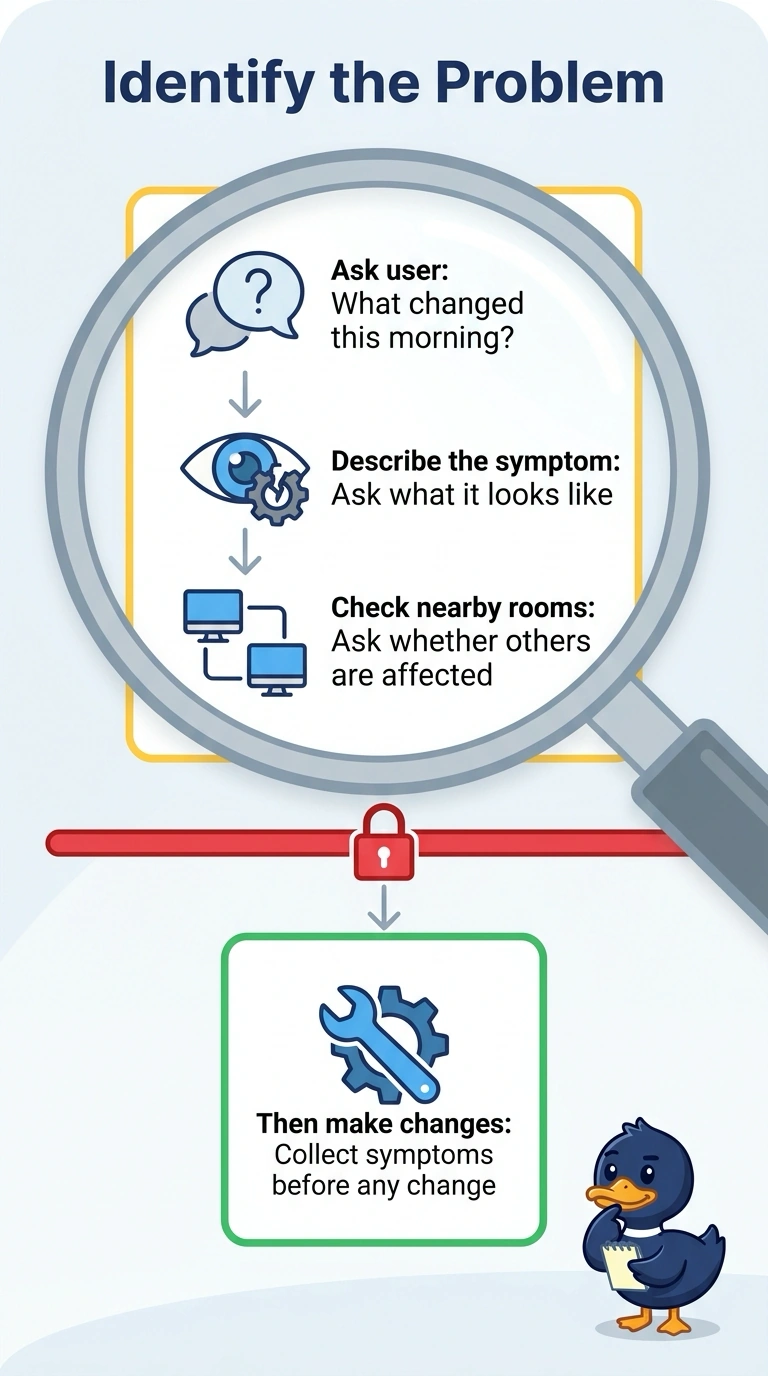
A teacher reports that the classroom display is off the network. The technician has not asked what changed this morning, what the symptom looks like, or whether any neighboring room is affected. Which step comes next?
Select an answer to reveal the explanation.
Short Explanation
You don’t start a repair by ripping out the wall. Identify the problem first: ask the teacher what changed, what the screen is doing, and whether anyone else is affected; swapping fiber or moving the display to a new VLAN before you know the symptoms can turn a small ticket into a bigger outage.
Full Explanation
The troubleshooting method starts by identifying the problem. You gather information, question the user, identify symptoms, ask what changed, and find out whether the problem can be reproduced. The technician has none of that yet, so the next step is still identification, not a change. A plan to replace the display, access switch, and closet uplink together skips diagnosis and ignores the need to treat multiple problems individually. Moving the display to a new VLAN before confirming a cause skips theory testing and risks side effects from a change whose impact is unknown. Swapping the closet uplink with a spare pair tests a fiber-cut theory, but the technician has not gathered enough evidence to support that theory. Asking what changed and what the symptoms are belongs to identifying the problem; forming and testing a theory comes after that. There is no report yet that another room on the uplink is affected. Exam caveat: once identification is complete, do not stay in interview mode indefinitely. A clear symptom and a recent change are enough to form a theory and test it. Practical check: record what the teacher saw, what changed this morning, and whether the neighboring room is affected; then decide whether to test the display, wall port, or closet.