
Users on a trading floor say the internal market feed stutters. The switch uplink to the feed server shows output drops climbing and utilization pinned at the interface rate. Ping loss appears only while the drops are climbing. Which problem does that pair of symptoms indicate?
Select an answer to reveal the explanation.
Short Explanation
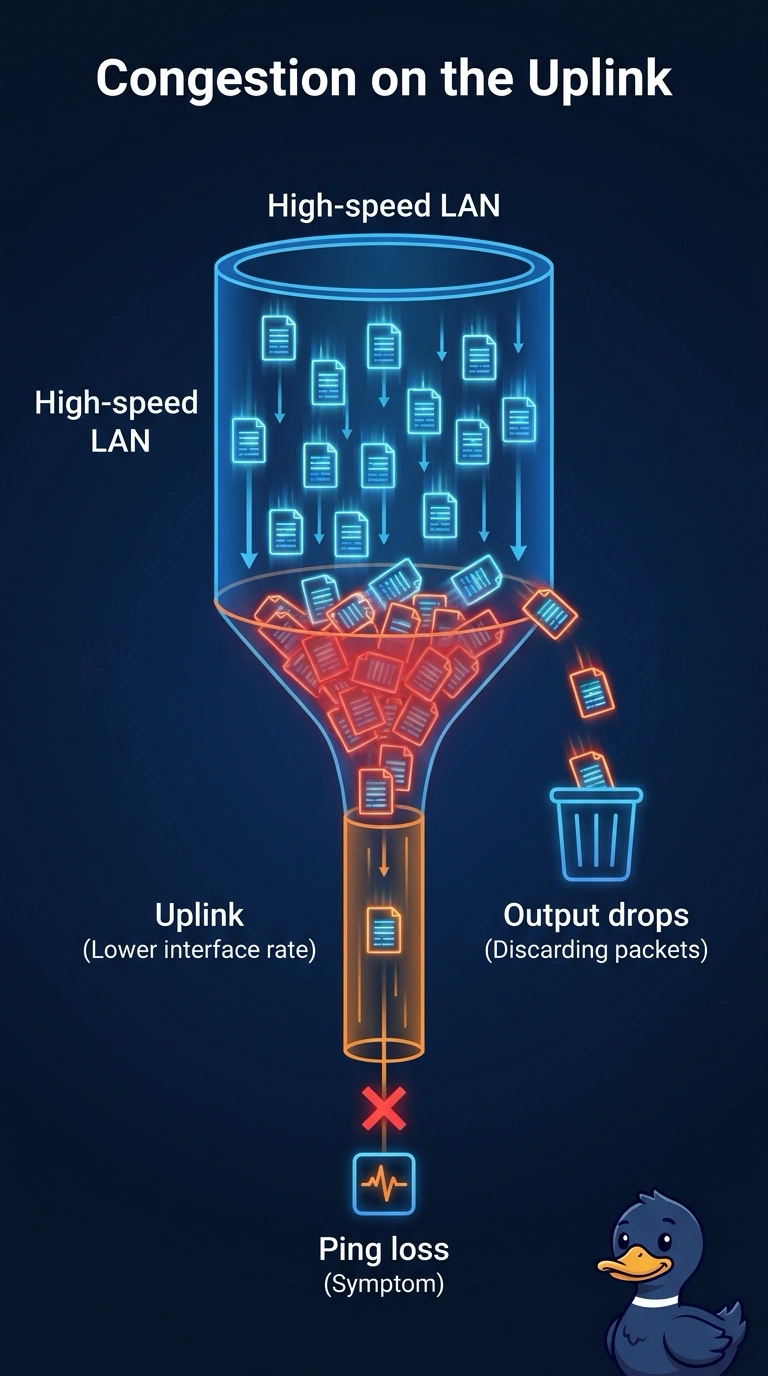
The pipe is full, and whatever does not fit is falling on the floor. You can see the uplink sitting at its line rate while output drops climb, and pings vanish only in those same moments, which is congestion. A slow trip with room left on the link, or an uneven delay, would not pin the port and fill the output queue.
Full Explanation
When offered traffic exceeds what an interface can serialize, the output queue fills and the device discards packets it cannot send. Those discards show up as output drops, and utilization sits at the interface rate because the link is already sending as fast as it can. Packet loss that appears only during that condition is the user-visible side of the same queue overflow. The market-feed stutter fits congestion on the uplink. High latency is the tempting twin, because users describe a stutter as slowness. Latency delays packets that are still delivered. It does not by itself pin utilization at the line rate or increment output drops. Jitter is variation in that delay. It hurts playback and it is not what the output-drop counter measures. A duplex mismatch causes errors, often collisions or runts on the half-duplex side, and it does not present as a clean full-rate output queue discarding frames it has no room to send. The stem's pair, line rate plus output drops, is the congestion signature. Exam caveat: drops prove the queue overflowed. They do not tell you whether the fix is a faster link, a move of a heavy flow, or a policy that protects the feed. Operational check: identify the conversations using the uplink during the drops, confirm the feed is among them, and retest loss after that contention is removed or the link is enlarged.