
Phones at a call center play a stretch of clear audio and then a burst of clipped words. One-way delay stays near 40 milliseconds and packet loss stays near zero. Which impairment matches that pattern?
Select an answer to reveal the explanation.
Short Explanation
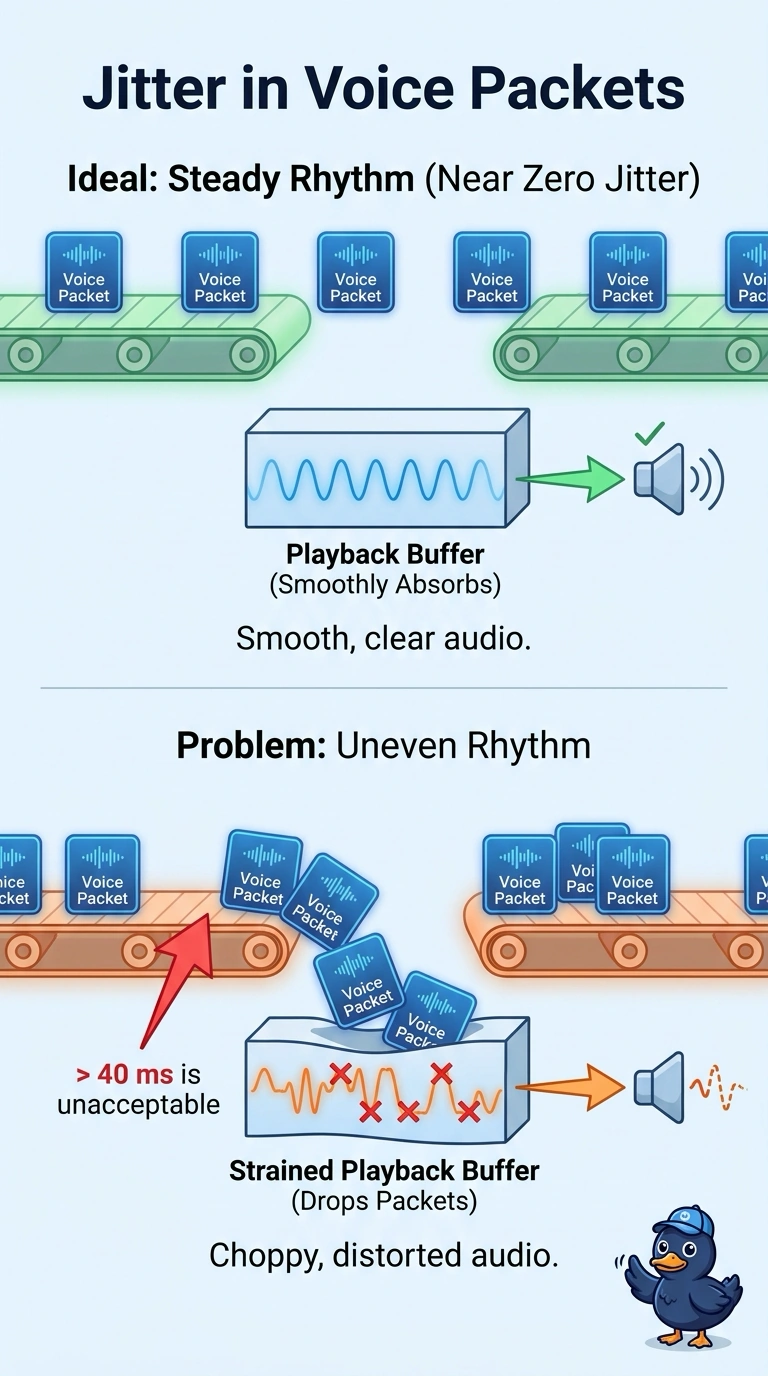
Latency is how long the trip takes, and jitter is whether every trip takes the same time. Your calls stay near 40 milliseconds with almost no loss, yet the words arrive in clumps, so the playback buffer is losing the rhythm. That uneven spacing is jitter, and clipped audio makes loss look guilty even though the counter says almost nothing was dropped.
Full Explanation
Jitter is variation in delay from one packet to the next. A voice endpoint plays packets on a schedule, using a jitter buffer to absorb small differences. When the gaps between packets swing too widely, the buffer under-runs and the caller hears a clear moment followed by clipped words, even though the average one-way delay stays near 40 milliseconds and almost nothing is lost. That is the pattern in the call center. Packet loss is the tempting cause, because clipped words often mean frames were discarded, and the stem says loss stays near zero. The clip is coming from uneven arrival, not from missing packets. A circuit smaller than the codec's rate would keep the call from sustaining at all, and it would usually show loss or a starved flow rather than a steady 40 millisecond delay. Uniform latency makes the conversation feel slow, and it does not chop individual words if every packet is late by the same amount. The stem's delay is both small and steady. Exam caveat: a buffer can hide modest jitter and cannot hide an unbounded amount. Raising the buffer adds delay, so the fix may be to smooth the path, not only to enlarge the buffer. Operational check: measure inter-arrival variation on the voice stream during a choppy call and confirm it spikes in time with the clipped audio while loss and average delay stay inside the codec's limits.