
A school technician must find which patch-panel port and which switch port connect to a classroom wall jack labeled B-14, without unplugging working cables to test them. Which record answers that directly?
Select an answer to reveal the explanation.
Short Explanation
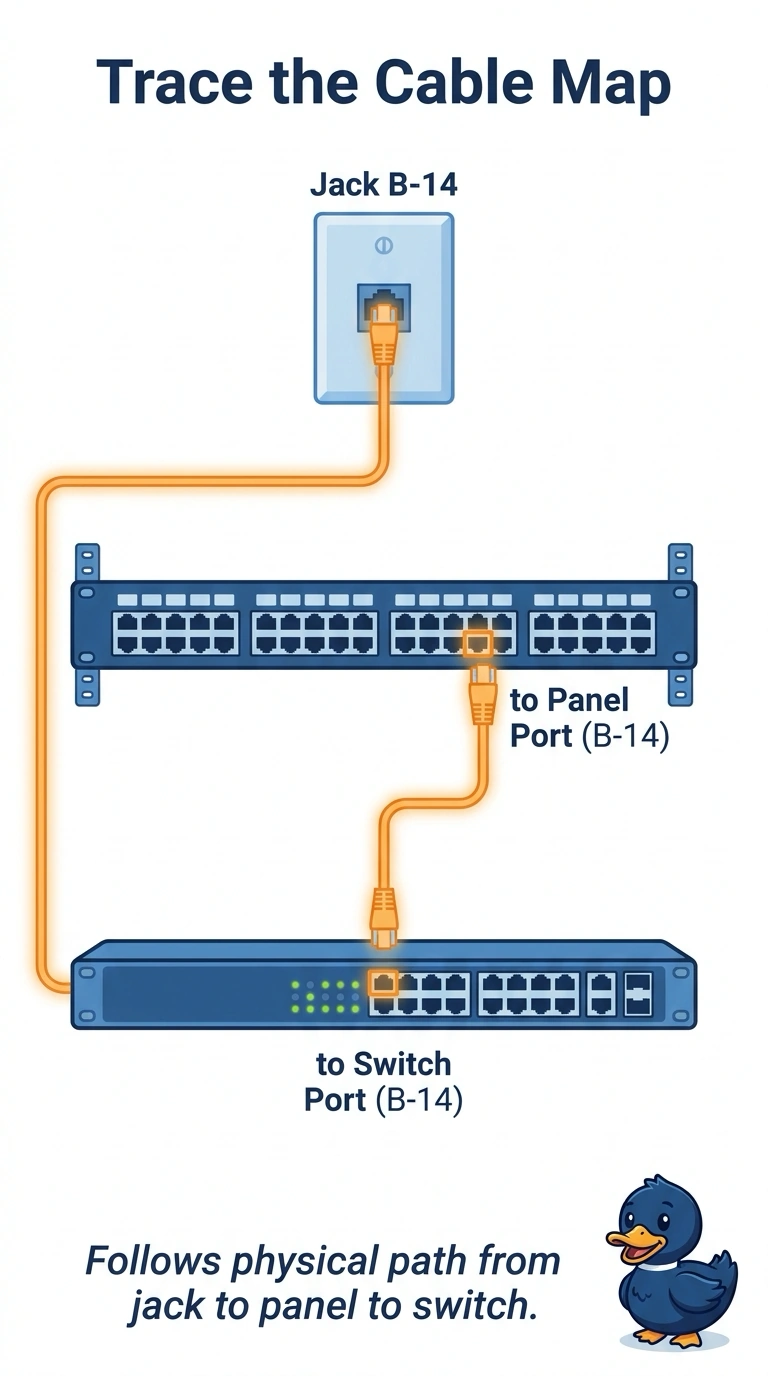
You need the wiring equivalent of a seating chart, not a map of the bus routes. A cable map shows which panel port and switch port serve wall jack B-14; VLANs, subnet assignments, and the switch’s rack location won’t tell you which connection to follow.
Full Explanation
A cable map records the physical identity of each run: the faceplate label, patch-panel port, switch port, and often the cable identifier. It lets you find jack B-14 without toning or unplugging working cables. A logical diagram shows VLAN numbers, routed subnets, and how traffic flows between buildings; although the classroom may have a VLAN, that diagram does not name the panel port or switch port serving the jack. An IP address inventory lists which subnet is assigned to each classroom VLAN, but it does not trace the physical connection from the jack to the panel and switch. A rack diagram shows which rack unit holds the access switch, so it can help you locate the device but cannot identify which jack lands on which port. Exam caveat: VLAN and subnet information describes logical network organization, not the physical path of an individual cable run. Practical check: look up B-14 on the cable map, then confirm that the jack label, panel port, and switch port agree before moving any patch cord.