
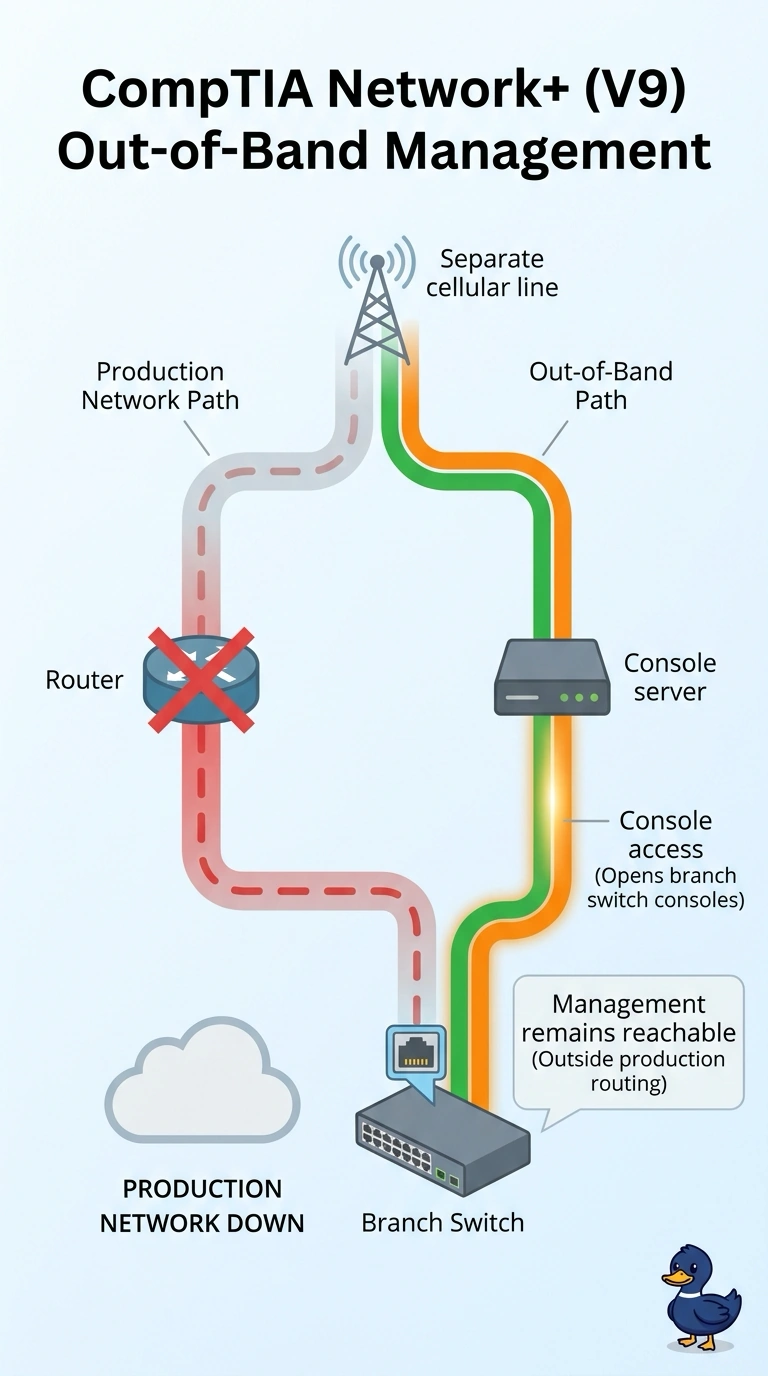
A storm knocks down routing between a library and its branch, and the branch switches stop answering their management addresses. Staff can still open those switch consoles through a console server reached over a separate cellular line. Which management path is the cellular console server?
Select an answer to reveal the explanation.
Short Explanation
In-band management travels on the same roads as everyone else's traffic, so when those roads close you are locked out. You reached the branch on a separate cellular line and then used the console, which is the side door. That side door is out-of-band management, while a jump host that lives only on the failed wide-area circuit is still in-band.
Full Explanation
Out-of-band management uses a path that does not depend on the production forwarding plane. A console server attached to the switches' console ports, reached over its own cellular line, still works after the routed network between the library and the branch has failed. That separate path is why staff can still open the consoles. In-band management uses production addresses on the production network, such as the management addresses that stopped answering. Those addresses are exactly what the storm removed. A site-to-site VPN is an encrypted tunnel between routed endpoints. If the only wide-area circuit is down and the VPN depended on it, the tunnel is down too. A jump host is the tempting cousin of the console server, because both are a place you log in so you can reach a device. A jump host that exists only across the failed production circuit is unreachable for the same reason the management addresses are, so it is not the path that still works. Exam caveat: the cellular line itself needs power and a reachable provider. Out-of-band fails too if the console server and the radio are on the same dead breaker as the switches. Operational check: during a maintenance window, shut the production uplink and confirm the console server is still reachable over cellular and that each switch console still opens.