
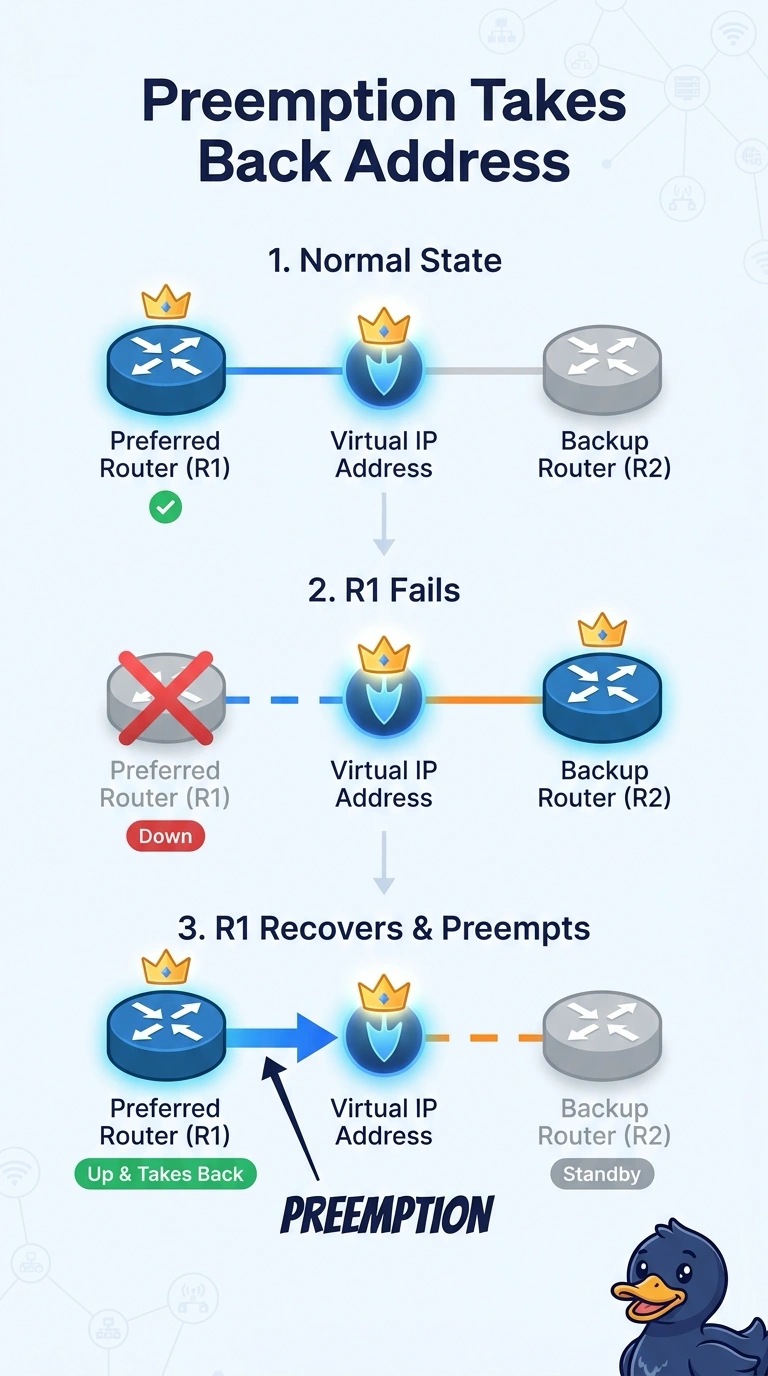
Two routers at a clinic share a virtual gateway address. After a failure the backup held that address. When the preferred router returned, the virtual address moved back to it. Which feature did that?
Select an answer to reveal the explanation.
Short Explanation
The spare driver kept the wheel while the usual driver was gone, and the usual driver took the wheel back on returning because the team agreed the usual driver outranks the spare. That takeover-on-return is preemption. The hosts keep the same virtual gateway the whole time, so you do not need to hand them a new address from DHCP or DNS.
Full Explanation
First-hop redundancy gives hosts one virtual gateway address that can move between routers. Preemption lets the preferred router take that virtual address back when it returns to service, which is what happened at the clinic. Without preemption the backup would keep the active role until it failed. Hosts are configured with the virtual address, not with a physical address that changes, so they do not need a DHCP renew to follow the virtual address. Spanning tree elects a root bridge and blocking ports. It does not move a first-hop virtual IP. A DNS TTL affects how long a name-to-address answer is cached. The gateway hosts use is an IP configuration, not a DNS name in this design. Exam caveat: preemption can cause an extra failover when the preferred router returns, so the priority and delay should be set on purpose. Operational check: fail the preferred router, confirm the backup owns the virtual address, restore the preferred router, and confirm the virtual address returns only because preemption is enabled.