
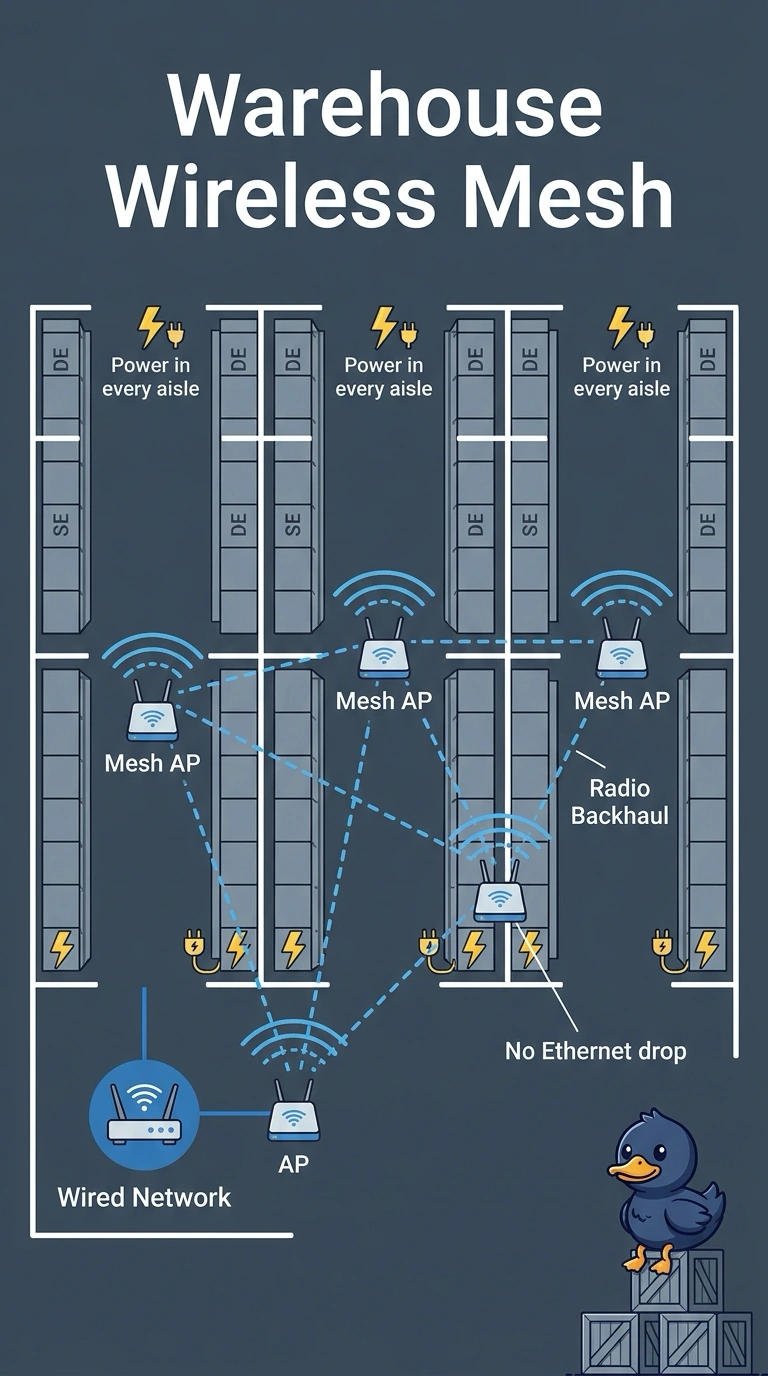
A warehouse has power in every aisle and no Ethernet drop for most aisles. Access points must backhaul by radio through neighboring access points to the wired network. Which design fits?
Select an answer to reveal the explanation.
Short Explanation
The aisles have outlets and no data jacks, so the access points have to pass messages to each other over the radio until one of them can touch the wired network. That relay among access points is a wireless mesh. Scanners talking only to each other, a single bridge between buildings, or a design that demands a cable in every aisle all miss the backhaul you actually have.
Full Explanation
A wireless mesh lets access points connect to neighboring access points by radio and forward client traffic until it reaches an access point that has a wired uplink. The warehouse has power everywhere and Ethernet in only a few places, so a mesh backhaul matches the building. An ad hoc network is a direct client-to-client connection with no access point. It does not provide a shared infrastructure for the aisles. A point-to-point bridge links two sites. It is not a coverage design for many aisles. Infrastructure mode in its ordinary form assumes each access point has a wired uplink. Requiring that drop is the constraint the warehouse cannot meet. Exam caveat: mesh backhaul shares the radio with client traffic unless the design uses a separate radio for the backhaul, so capacity planning still matters. Operational check: confirm one or more root access points have a working Ethernet uplink and that a far-aisle client can reach the wired gateway through the mesh. Give the mesh more than one access point with a wired uplink, because losing the only root isolates every aisle that depended on it.