
A campus edge learns internal routes from OSPF, which uses administrative distance 110 on this router. A backup static route for the same prefix uses distance 200 and should be used only if the OSPF route disappears. What is that static route?
Select an answer to reveal the explanation.
Short Explanation
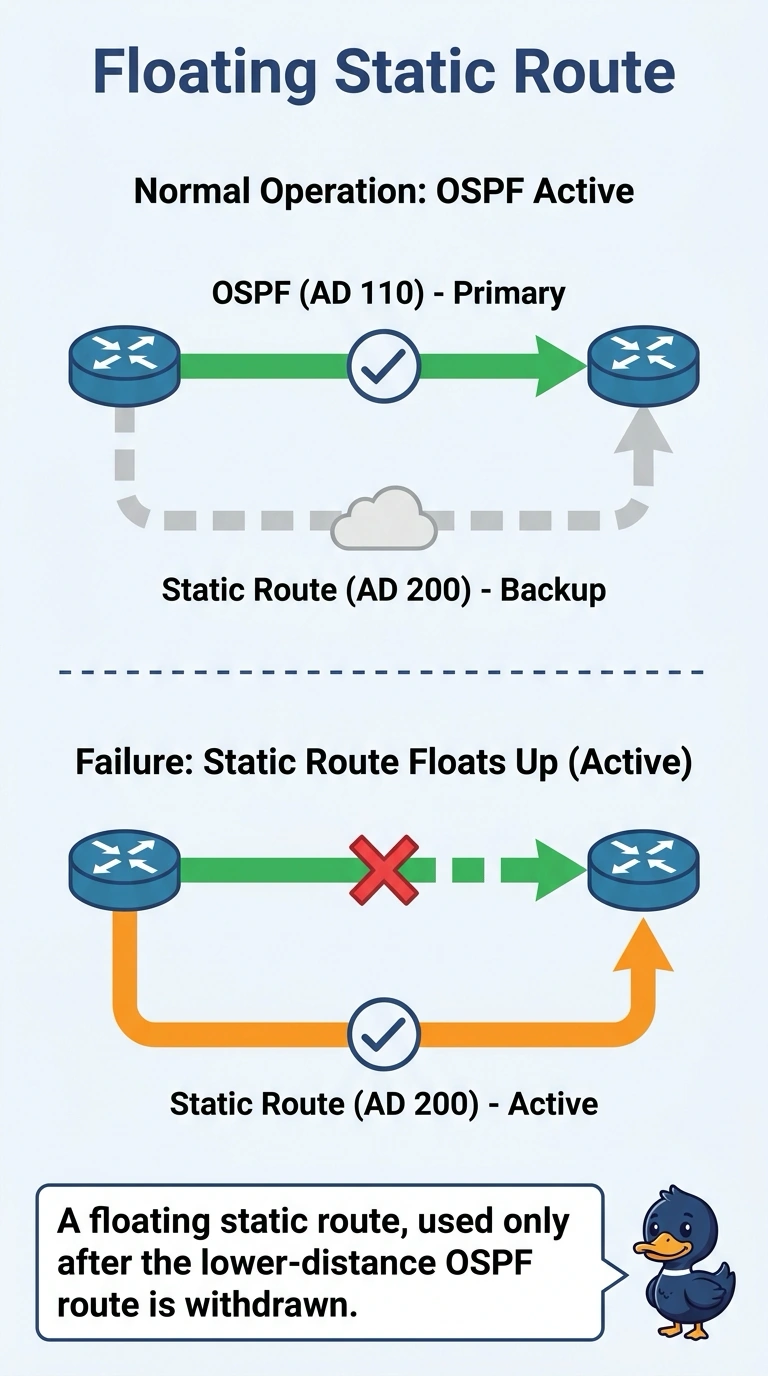
You keep a spare key in a drawer that only opens after the main key is lost. A floating static route is that spare: its distance is worse on purpose, so it sits unused while OSPF is healthy and steps in only when the OSPF route is gone. A higher distance does not mean the routes share the load.
Full Explanation
A floating static route is a static route configured with an administrative distance higher than the dynamic route for the same prefix. OSPF is using 110 and the static route uses 200, so OSPF wins while it is present. When the OSPF route is withdrawn, the static route becomes the best remaining candidate and is installed. That is the backup behavior the campus asked for. A default route is a route to 0.0.0.0/0. It does not replace specific OSPF prefixes while those prefixes are still being learned, and this static route is a backup for one prefix, not a replacement for the whole OSPF table. Equal-cost load balancing requires equal metrics from the same routing source. A worse administrative distance makes the static route lose, not share. A first-hop redundancy protocol shares a virtual gateway address between routers on a LAN. It is not an administrative distance on a static route toward an ISP. Exam caveat: the floating route must point at a next hop that is still reachable by a connected or otherwise valid path, or it cannot install when OSPF withdraws. Operational check: look at the routing table while OSPF is up and confirm the OSPF route is installed, then simulate an OSPF withdrawal in a change window and confirm the distance-200 static route appears.