
One distribution switch is set to bundle two uplinks with LACP. The peer switch leaves those ports as separate access ports, and no bundle forms. What must change?
Select an answer to reveal the explanation.
Short Explanation
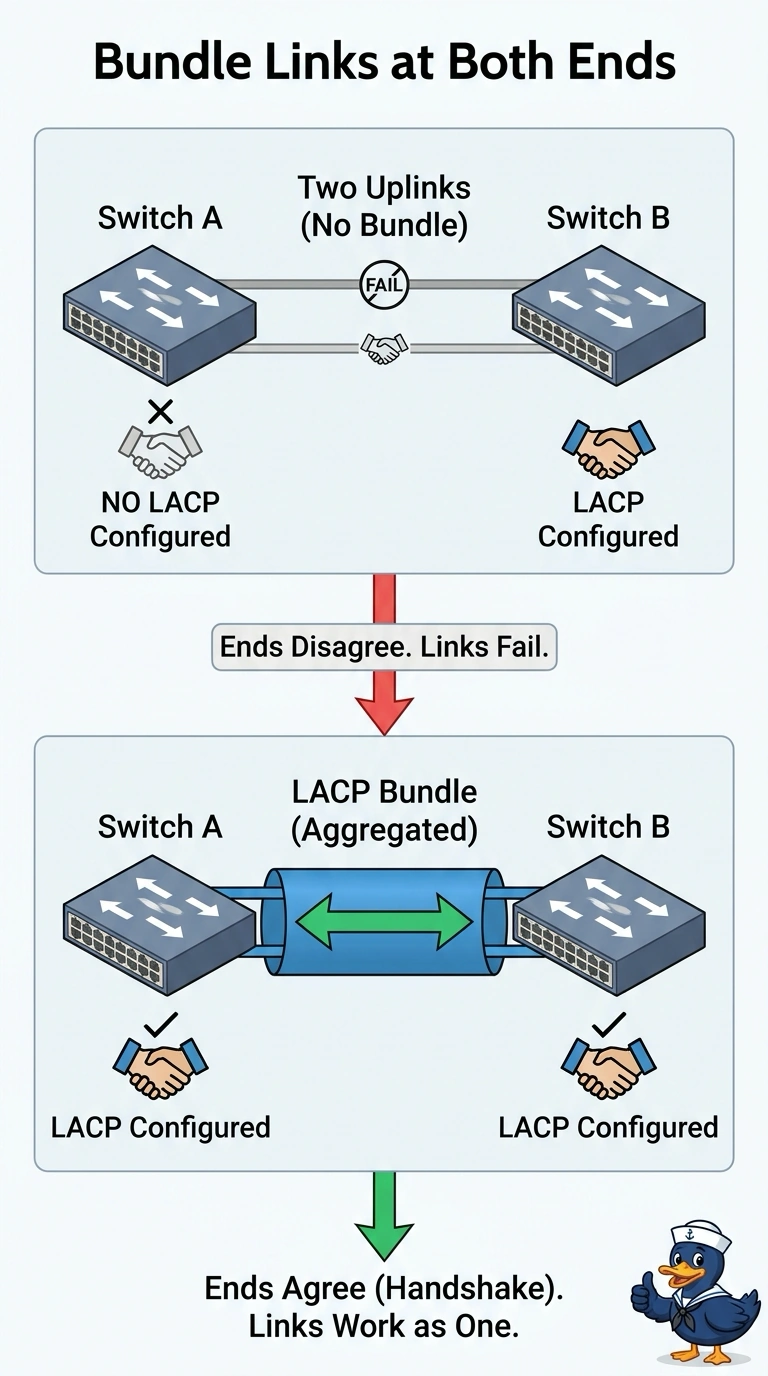
A handshake only works if both people offer a hand. One switch is asking to bundle and the other is treating the cables as two ordinary ports, so you configure aggregation on the peer as well. Spanning tree, a native VLAN, and a larger frame size do not substitute for that agreement.
Full Explanation
Link aggregation, including LACP, forms a bundle only when both ends are configured to participate. The distribution switch is willing and the peer still has two independent access ports, so the peer never negotiates the bundle. Spanning tree blocks redundant links to prevent loops. It does not bundle them into one logical link. A native VLAN mismatch can misplace untagged frames on a trunk that is already up. Matching it does not create an aggregation. Jumbo frames change the maximum payload size. LACP can form between switches that are still using a standard Ethernet payload. Exam caveat: one side can be active and the other passive, but a side that is not in the aggregation at all will never join. Both ends still have to be members. Operational check: put both ports on the peer into the same aggregation, confirm the bundle shows both members forwarding, and verify spanning tree sees one logical link rather than two. During a maintenance window, shut one member of the finished bundle and confirm traffic stays up on the remaining member.