
Two neighboring warehouse access points both use 80 MHz channels in the 5 GHz band, and clients between them show high retries. SSIDs and security already match. Which change addresses the overlap?
Select an answer to reveal the explanation.
Short Explanation
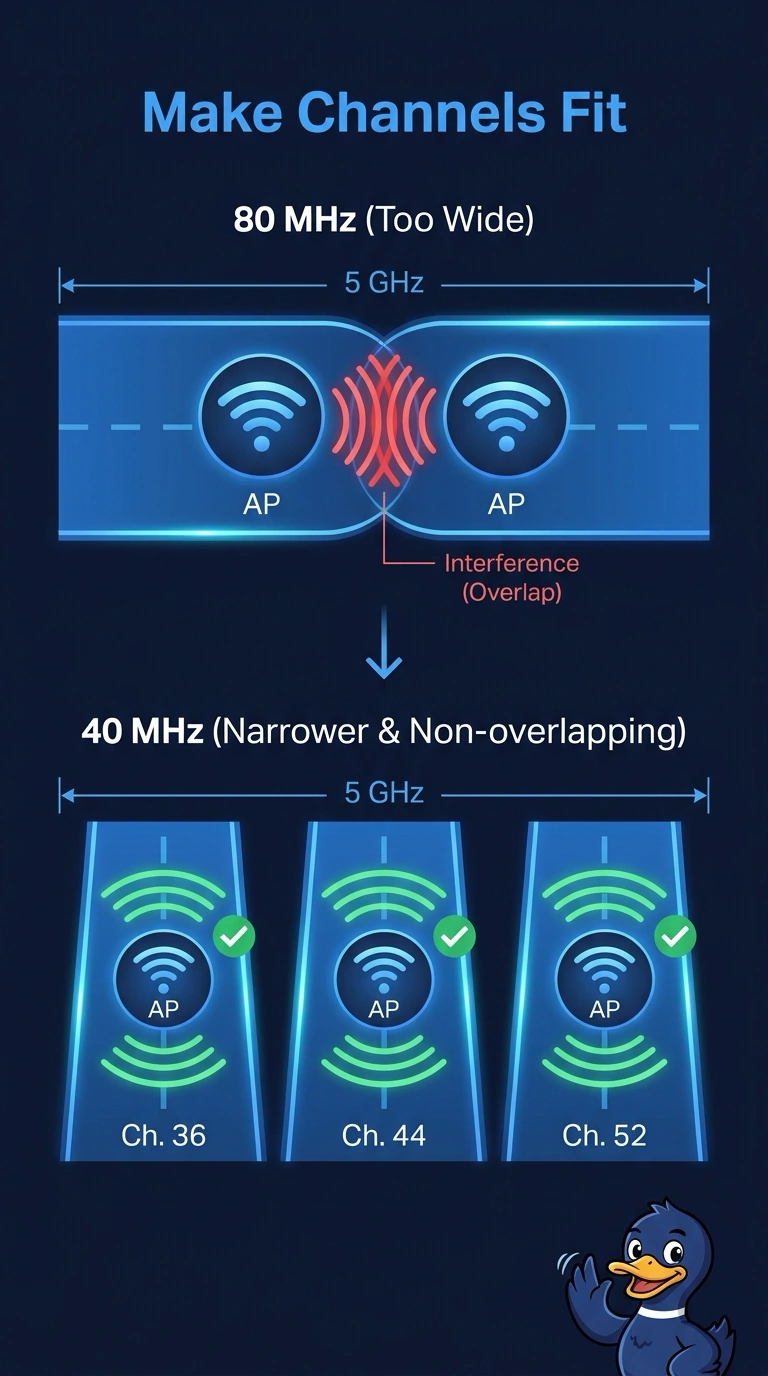
Two wide spotlights aimed at the same patch of floor wash each other out. Narrower beams, meaning a smaller channel width, let you park the radios on channels that do not overlap. Making the beams even wider, hiding the network name, or tweaking a frame size on a router does not separate those radios.
Full Explanation
Wider channels bond spectrum to raise the possible data rate, and they also consume more of the band, so neighboring radios overlap and retry. Both warehouse access points are on 80 MHz channels and the clients between them retry, while the names and security modes already match. Narrowing the width frees enough 5 GHz spectrum for a non-overlapping plan. Moving to 160 MHz bonds still more spectrum and makes overlap worse, not better. Hiding an SSID only stops the name from being broadcast. The radios still occupy the same overlapping channels. Jumbo frame size is an Ethernet payload setting on wired gear. It does not select a 5 GHz channel or change how much spectrum a radio uses. Exam caveat: a wider channel is reasonable when the spectrum is empty and the client needs the throughput. It is the wrong fix when the stem already shows overlap and retries. Operational check: survey the aisle, set a channel width the band can support, and assign the two radios non-overlapping channels, then confirm the retry rate drops.