
A new OSPF area on a campus was connected only to area 2. Routers in the new area cannot complete inter-area routing. Which change follows the OSPF design rule?
Select an answer to reveal the explanation.
Short Explanation
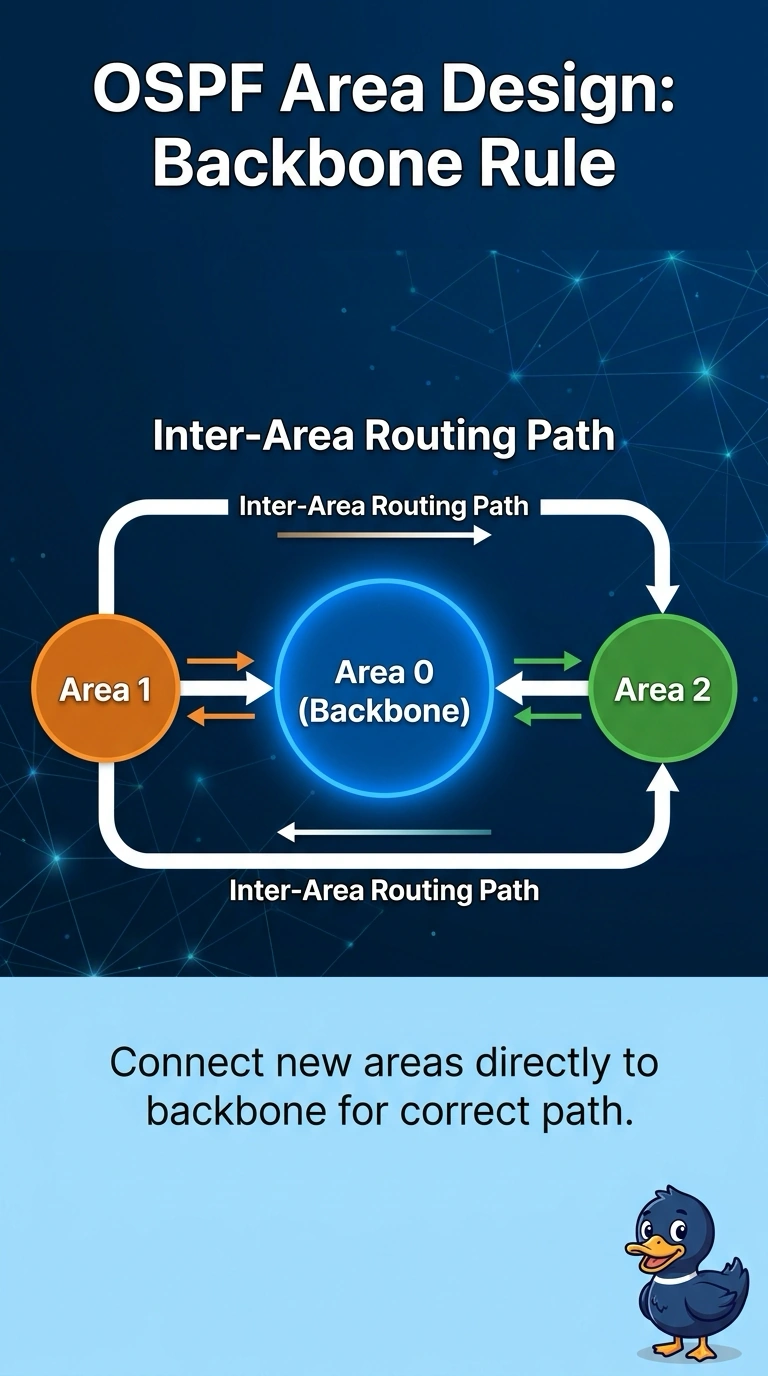
Every wing of this building is supposed to touch the main corridor, and the new wing was attached only to another wing. You connect the new OSPF area directly to backbone area 0 so inter-area routing has the path the design requires. A second link into area 2, a second backbone, or a BGP detour does not follow that rule.
Full Explanation
OSPF inter-area routing is built through the backbone, area 0. A non-backbone area is supposed to connect to area 0. This new area connects only to area 2, so inter-area routing stays broken. Connecting it directly to area 0 is the design rule. A second link to area 2 is the tempting twin because it adds redundancy. It still never touches area 0. Renumbering the new area as area 0 while the existing backbone is also area 0 creates two backbones, which is not one connected backbone. Redistributing into BGP moves the problem to another protocol and skips the OSPF backbone path. Exam caveat: the new area and area 0 have to share a router with an interface in each, and that router has to form both adjacencies. A cable into a switch that is not in area 0 does not satisfy the rule. Operational check: confirm a router has an adjacency in the new area and an adjacency in area 0, then confirm a prefix from the new area is visible in another area. Record the reading before the change and the reading after it so the next shift can see the symptom actually moved.