
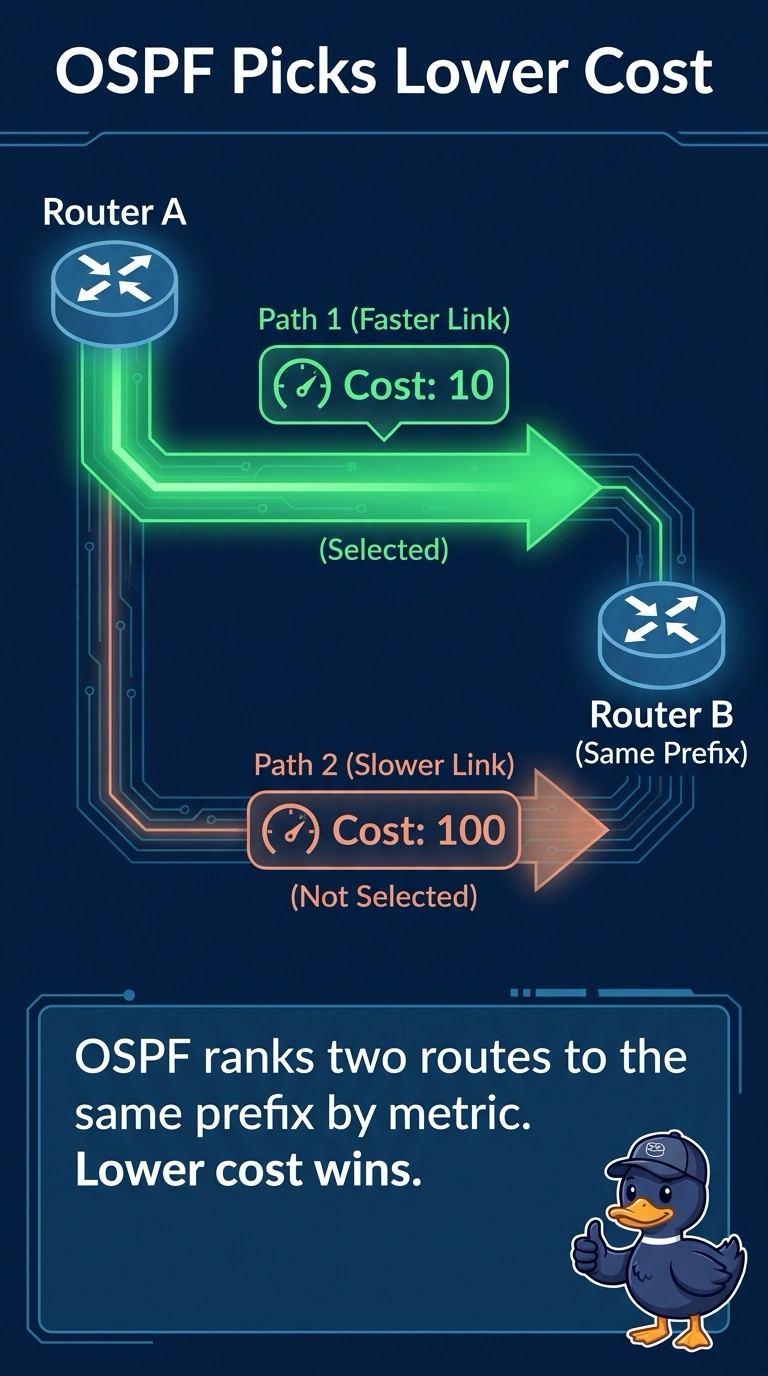
A data-center router learns the same server prefix by OSPF on two paths. One path has a lower OSPF cost than the other. Which path does OSPF place in the routing table?
Select an answer to reveal the explanation.
Short Explanation
When two roads are run by the same mapmaker, the cheaper toll wins. Both paths are OSPF, so you compare OSPF cost, and the lower cost is the path that goes into the table. Administrative distance is how a router ranks different sources, and a static route that is not even in the table is not the one carrying these servers.
Full Explanation
OSPF assigns a cost to each path and prefers the lowest cost to a given prefix. Both candidates here were learned by OSPF, so the path with the lower cost is installed and the higher-cost path is the alternate OSPF knows about. Administrative distance ranks routes learned from different sources, such as a static route against a dynamic protocol. Two OSPF routes to the same prefix share that ranking and are separated by the OSPF metric, not by administrative distance. A hop count that ignores cost can pick the wrong path, because OSPF may prefer a two-hop path of fast links over a one-hop path of a slow link. The metric in use is cost, not a raw hop total. A static route that does not appear in the routing table is not forwarding traffic. It cannot be the path OSPF installed for this prefix, whatever its preference would have been if it had been configured and selected. Exam caveat: if a static route to the same prefix is actually installed, its administrative distance can beat OSPF before cost is considered. That is a different table from the one in this stem, where the choice is between two OSPF paths. Operational check: inspect the route for the server prefix, confirm the next hop is the lower-cost OSPF neighbor, and confirm the higher-cost path is retained only as a backup if the platform shows one.