
A campus access point operating on 5 GHz leaves its channel as soon as it detects radar. Which behavior is that?
Select an answer to reveal the explanation.
Short Explanation
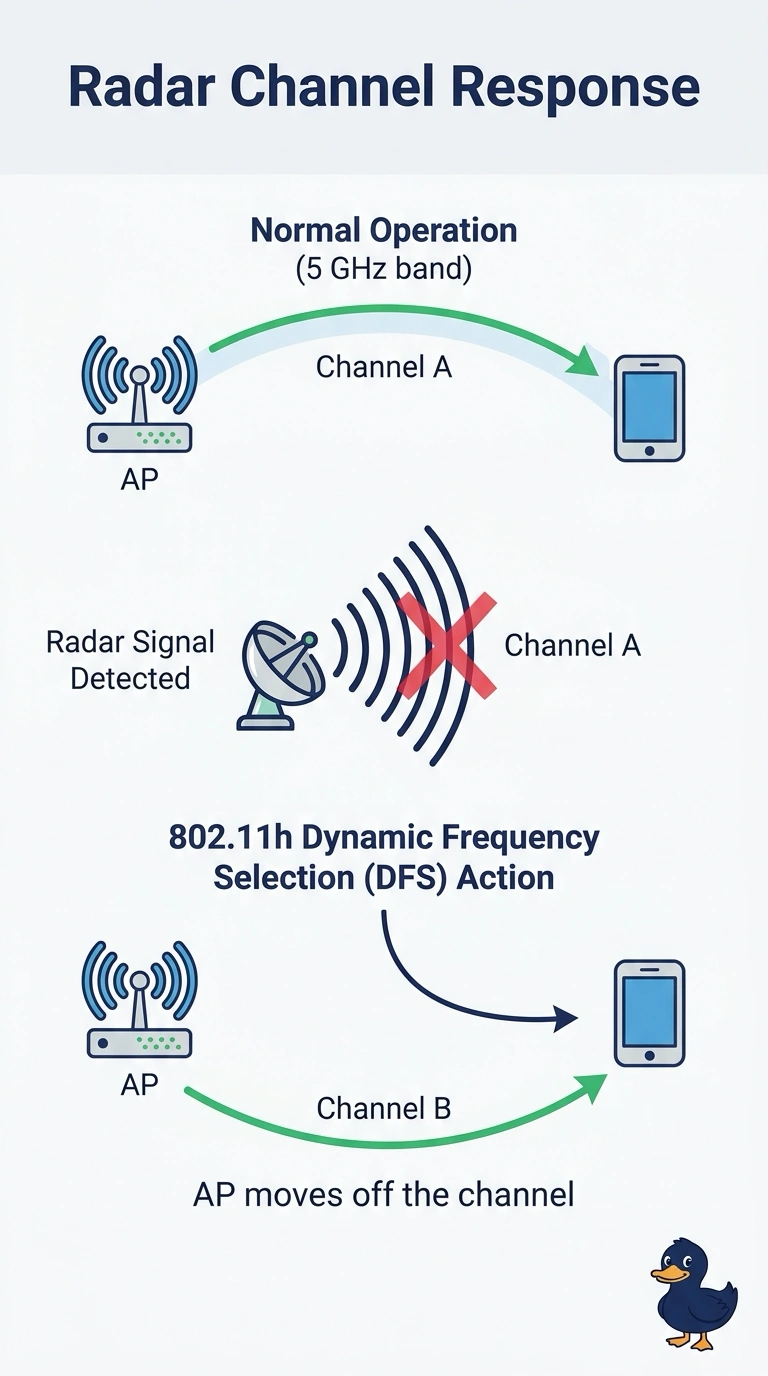
The radio heard a weather system using the channel and got out of the way. On 5 GHz that move is dynamic frequency selection under 802.11h, and your access point is leaving the channel because it detected radar. Steering clients to another band, a sign-in page, and a VLAN tag do not do that.
Full Explanation
IEEE 802.11h defines dynamic frequency selection for 5 GHz radios that share spectrum with radar. When the access point detects radar on its channel, it must stop using that channel and move to one that is clear. The campus radio leaving its channel on radar detection is that behavior. Band steering encourages dual-band clients to prefer 5 GHz over 2.4 GHz, or the reverse if someone configures it that way. It chooses a band for a client. It is not the radar response, and the stem does not say clients were pushed to 2.4 GHz. The access point itself abandoned a 5 GHz channel. A captive portal is a sign-in or acceptance page shown before internet access. It operates on associated clients' web requests and has no radar detector. 802.1Q inserts a VLAN tag in an Ethernet frame so trunks can carry many VLANs. It is a switching feature and does not monitor 5 GHz spectrum. Exam caveat: dynamic frequency selection applies to the 5 GHz channels that share spectrum with radar. A radio that never uses those channels will not show this move, and the feature is not a 2.4 GHz behavior. Operational check: after a radar event, confirm the access point logs a dynamic frequency selection change and is serving clients on a different 5 GHz channel.