
A factory router has one LAN port that must act as the gateway for three VLANs. The switch trunks all three VLANs to that port. How should the router be configured?
Select an answer to reveal the explanation.
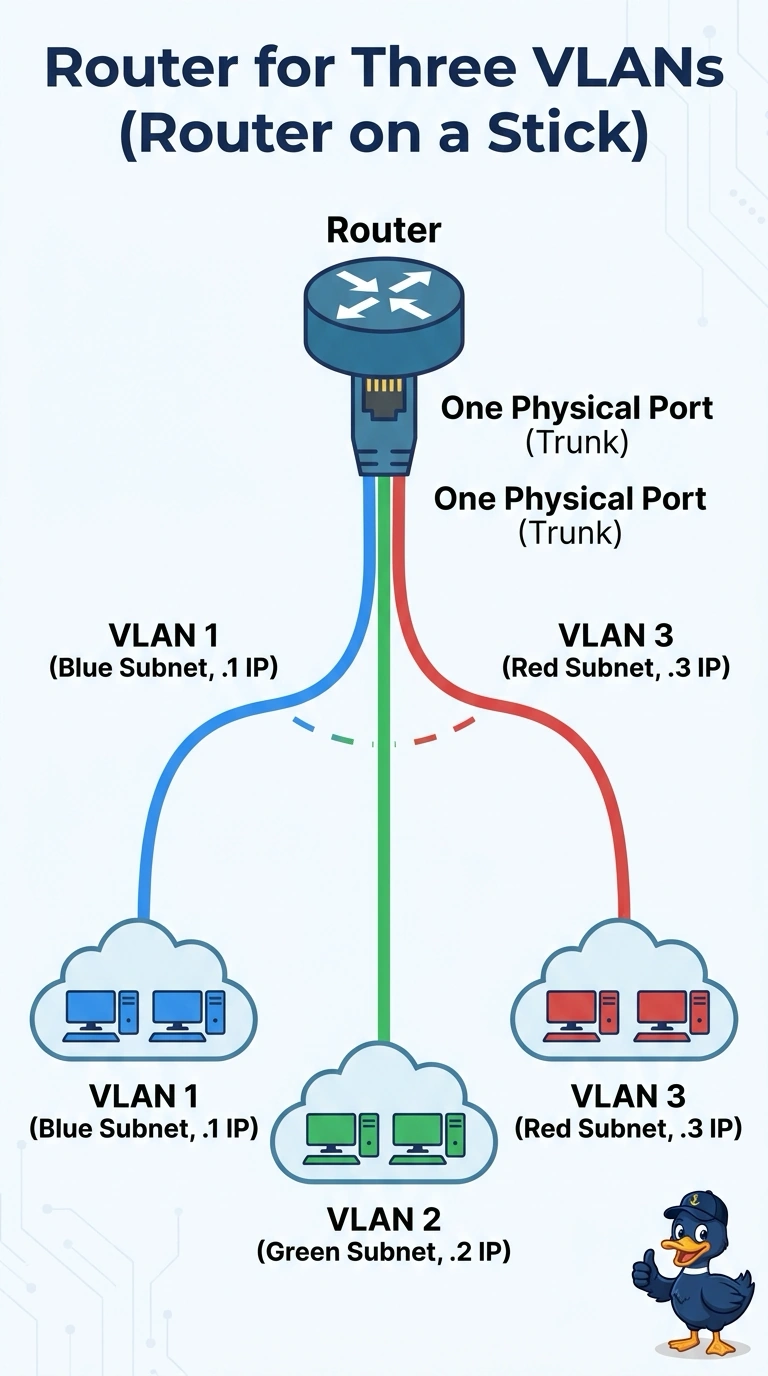
Short Explanation
One doorway can open onto three hallways if each hallway has its own number on the door. You create a subinterface per VLAN on the factory router's single LAN port and give each subinterface an address in that VLAN. One address cannot sit in three subnets, and one subinterface cannot wear three tags.
Full Explanation
The switch trunks three VLANs to the router's one LAN port, so tagged frames for each VLAN arrive on that single physical interface. The router distinguishes them with a subinterface per VLAN and an address from that VLAN's subnet. Hosts use the address in their own subnet as the gateway. One IP on the physical port can belong to only one subnet, at most the untagged VLAN. One subinterface that tries to carry every tag still has one address, so it cannot be a gateway inside three subnets. Three untagged addresses on the port ignore the trunk. Untagged frames are one VLAN, not three. Exam caveat: each subinterface's VLAN identifier must match the tag the switch sends, and the trunk must allow all three. Operational check: from a host in each VLAN, ping that VLAN's subinterface, and confirm the three addresses sit in the three subnets. Then confirm the switch trunk allows every VLAN the router configured, or the ping never leaves the closet. A host that can ping its own gateway and not the other two has a tag or an address in the wrong subnet.