
A factory and its parts supplier must exchange routes between their separate autonomous systems. Which protocol is built for that exchange?
Select an answer to reveal the explanation.
Short Explanation
Two companies are separate networks with their own routing policies, and the gate between them is not an interior hallway. You exchange those routes with BGP, the protocol meant for autonomous-system borders. OSPF and EIGRP are interior protocols, and a static default does not exchange each company's routes.
Full Explanation
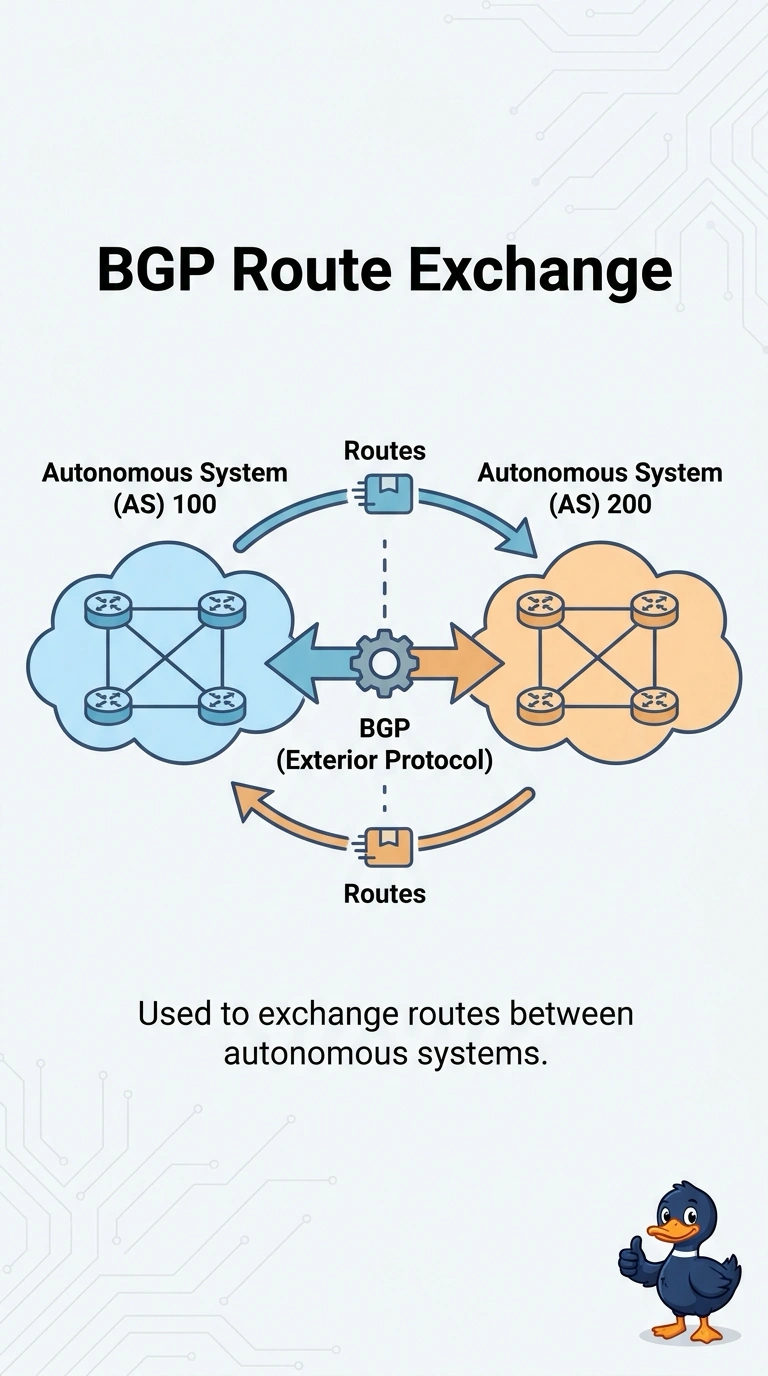
Border Gateway Protocol is the exterior routing protocol used when two autonomous systems exchange reachability. Each company keeps its own autonomous system, applies its own policy, and advertises selected prefixes to the neighbor. That is the factory-to-supplier relationship in this question. The protocol is built to carry routes between administrative domains rather than to compute a shortest path inside one organization. OSPF is an interior link-state protocol. It floods topology inside an area and assumes one routing domain. Running it as the inter-company protocol would glue two organizations into one interior design and would not provide the policy controls expected at an autonomous-system boundary. EIGRP is an advanced distance-vector protocol used inside an organization. It is not the exterior exchange between two autonomous systems. A static default on each side points at the other company and does not advertise each company's prefixes. The stem asks for an exchange of routes. Exam caveat: BGP also runs inside a single autonomous system as internal BGP. The scenario here is two companies, so the session that matters is the external one between their autonomous systems. Operational check: confirm each company has its own autonomous-system number, that a BGP session is established between the edge routers, and that each side receives only the prefixes the other intended to advertise.