
Two warehouse switches must carry several VLANs across one uplink, with each VLAN identified by a tag. Which method does that?
Select an answer to reveal the explanation.
Short Explanation
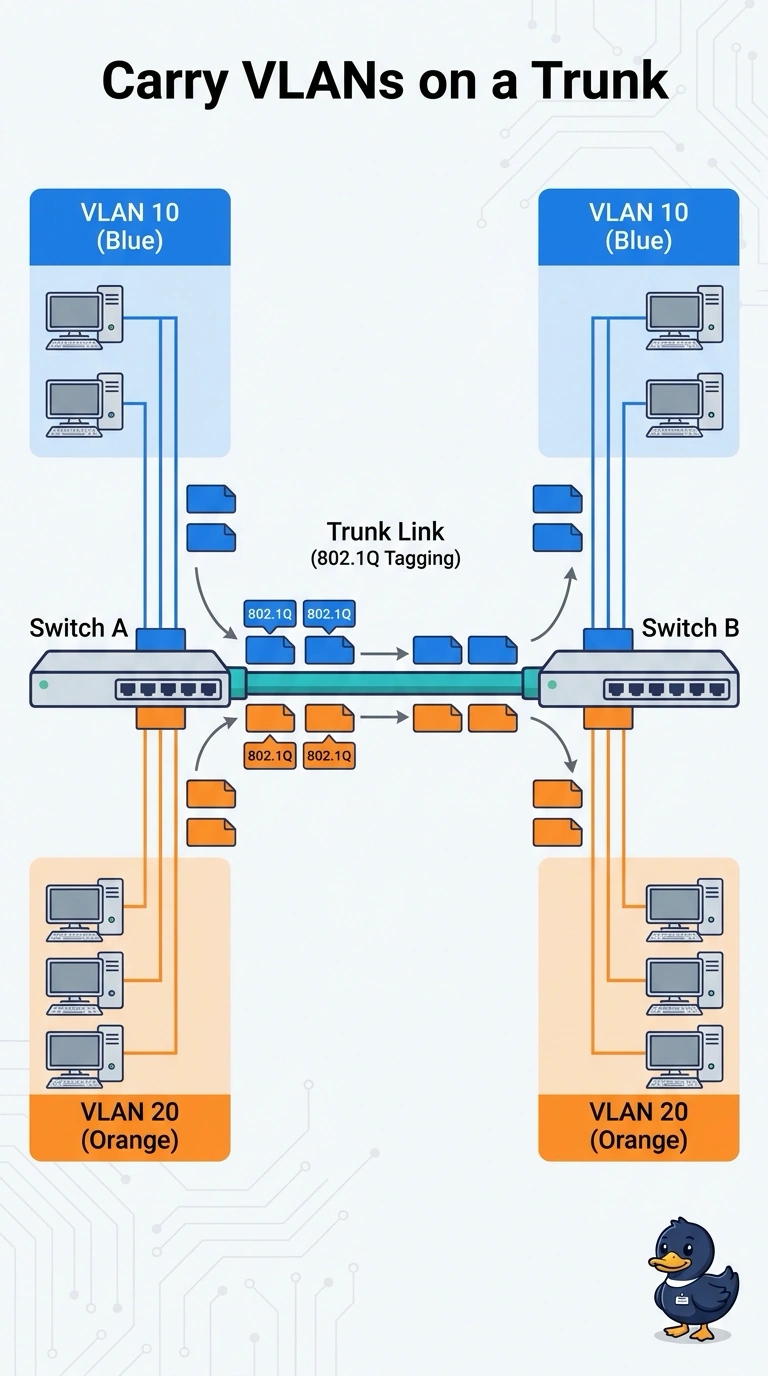
One road can carry many trucks if each truck wears a numbered tag. You put 802.1Q tags on the frames so several VLANs share the warehouse uplink and stay distinct. Rewriting addresses, sending everything untagged as one native VLAN, or declaring a label protocol the only option does not identify those VLANs.
Full Explanation
IEEE 802.1Q inserts a VLAN tag in the Ethernet frame so a trunk can carry many VLANs on one link. Each frame's tag tells the far switch which VLAN the frame belongs to. That is how the warehouse uplink can pass several VLANs without mixing them. Port address translation rewrites private source addresses to one public address and tracks source ports. It is a router or firewall function for internet access, and it does not mark Ethernet frames with a VLAN identity between two switches. A native VLAN is the VLAN that crosses a trunk untagged. If tagging is turned off for every VLAN, the uplink has no tag to tell the VLANs apart and they collapse into a single untagged broadcast domain. That fails the requirement that each VLAN be identified. MPLS labels can carry traffic across a provider or a campus core, and a design might use it for other reasons. It is not the method two ordinary switches use to separate VLANs on a trunk, and it is not the only way to do so. 802.1Q is the standard tagging method for this job. Exam caveat: the native VLAN is untagged by default, so both ends must agree on it. A mismatch does not mean tagging itself is the wrong tool. Operational check: confirm the uplink is a trunk, confirm each required VLAN is allowed and tagged, and verify a host in each VLAN can reach its gateway while a capture on the trunk shows the matching tags.