
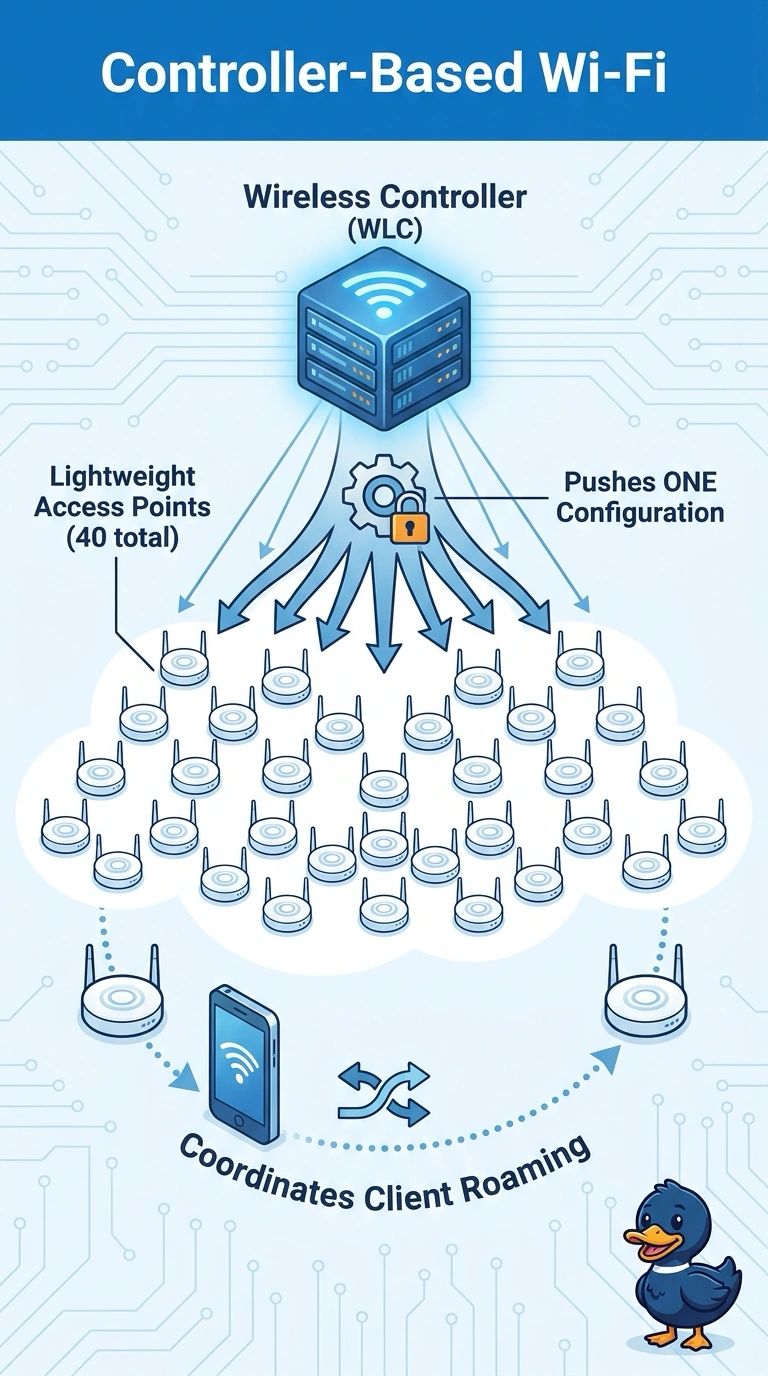
A warehouse wants forty access points to receive one configuration and to coordinate roaming from a controller. Which design fits?
Select an answer to reveal the explanation.
Short Explanation
Lightweight access points are clerks who follow one office manual, and the controller is the office. You want all forty warehouse radios to take a single configuration and to coordinate roaming from that controller. Forty autonomous radios, or a controller that pushes a config and leaves roaming to each radio, splits the job the warehouse asked to keep together.
Full Explanation
A lightweight access point joins a controller, downloads its settings, and lets the controller coordinate roaming. Forty warehouse radios can then share one configuration and hand clients off under that controller. Autonomous access points store their own configuration. Forty of them are configured one by one, and roaming does not come from one controller. They can share a name and still miss the requirement. Lightweight radios that store their own configuration and never join are autonomous radios under the other name. A controller that pushes configuration but leaves roaming to each radio does half the job. The stem asks for both the single configuration and coordinated roaming. Exam caveat: the controller becomes critical, so the warehouse needs a reachable controller and a plan for controller failure. Operational check: confirm all forty access points show as joined, change one shared setting, confirm they inherit it, and walk a client between two radios to verify the roam stays on the controller.