
A branch-office phone and a PC share one wall jack. The phone's frames are tagged into the voice network, and the PC stays untagged on the data network. Which switch feature creates that split?
Select an answer to reveal the explanation.
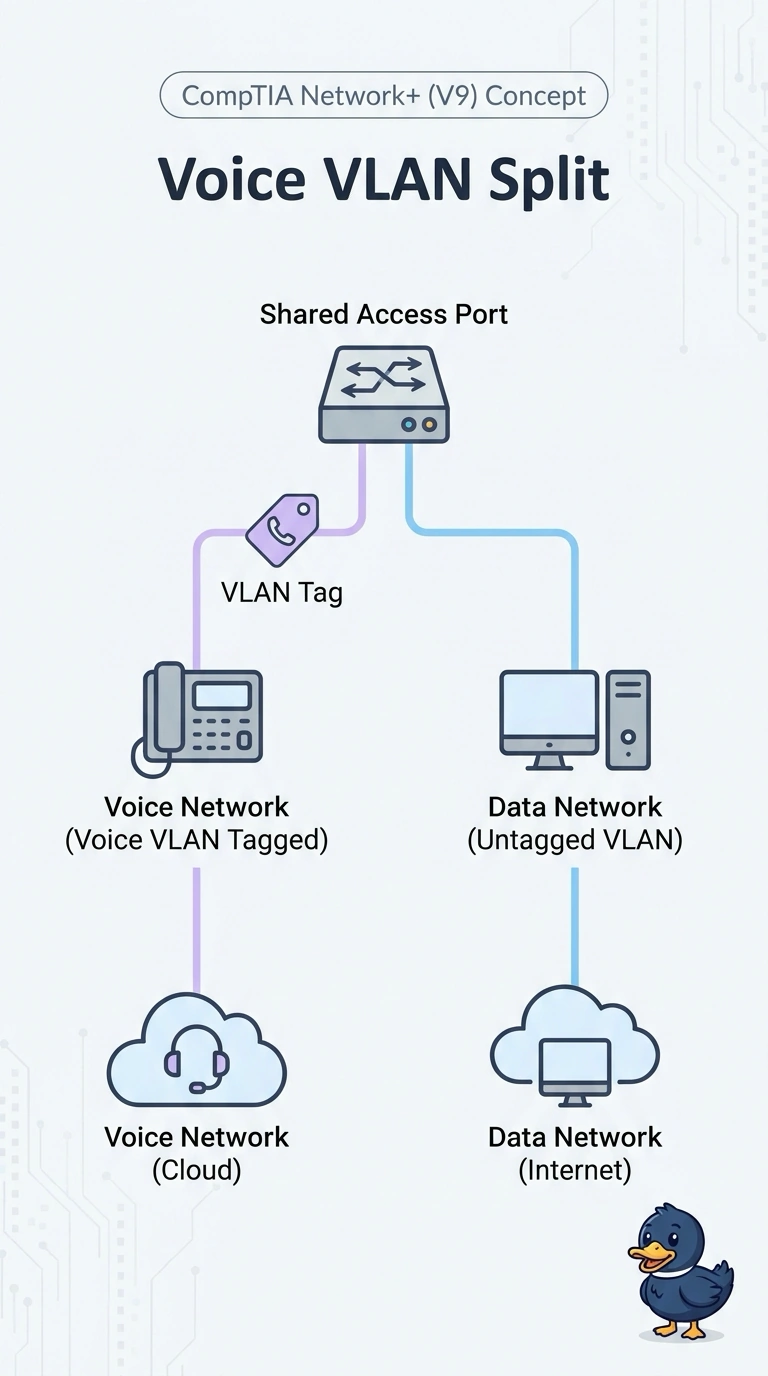
Short Explanation
One jack can serve two tenants if the phone wears a name tag and the computer does not. You configure a voice VLAN on that access port so the phone's frames are tagged and the PC stays untagged on the data VLAN. Tagging the PC instead, or tagging both, misses the split the office asked for.
Full Explanation
A voice VLAN is an access-port feature for a jack that has an IP phone and a PC sharing the port. The switch tags the phone's frames into the voice VLAN and leaves the PC's frames untagged in the data VLAN. Each VLAN then has its own subnet and gateway. That is the split the office described. Reversing it, tagging the PC and leaving the phone untagged, is the same feature with the roles swapped, and the stem says the phone is the tagged device. A trunk that tags both devices puts the PC in a tagged VLAN too, which is not the untagged data network in the stem. A native VLAN mismatch is a trunk fault: the two ends disagree about untagged frames. Using that disagreement on purpose mis-delivers traffic rather than classifying a phone. Exam caveat: the phone has to learn which VLAN to tag, and the voice VLAN must be allowed on the uplink. The access-port command is not enough if the uplink drops that VLAN. Operational check: confirm the data VLAN is untagged and the voice VLAN is tagged, then confirm the PC leases a data address and the phone leases a voice address.