
A university needs a dynamic routing protocol that floods link-state advertisements and computes a shortest-path tree. Which protocol does that?
Select an answer to reveal the explanation.
Short Explanation
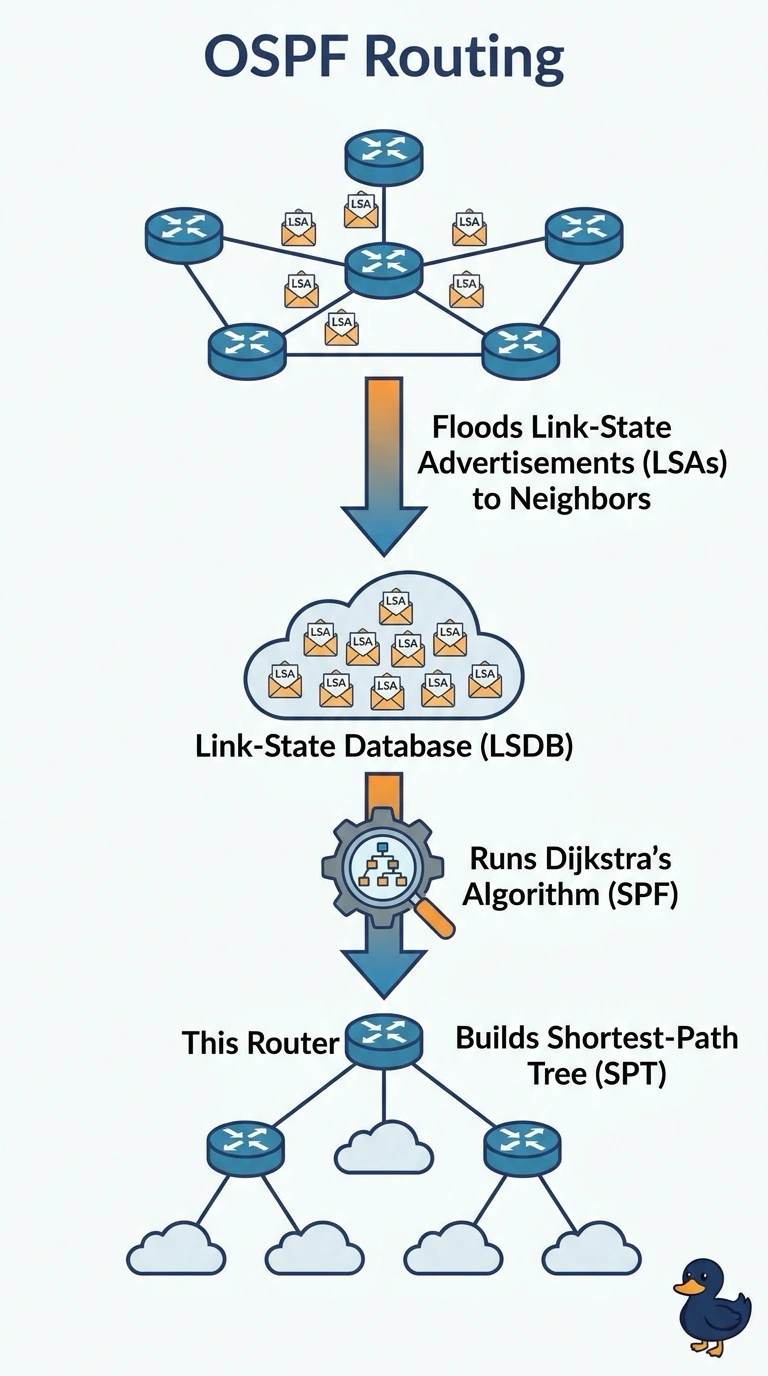
Link state is a group of friends who each read the whole map out loud and then compute their own shortest roads. You want the protocol that floods those link-state advertisements and builds a shortest-path tree, which is OSPF. A path-vector protocol, an advanced distance-vector protocol, and a route you typed by hand never hold that meeting.
Full Explanation
OSPF is a link-state routing protocol. Each router describes its own links in a link-state advertisement, floods those advertisements to the other routers in the area, and runs a shortest-path computation on the resulting map. Every router in the area builds the same picture of the topology and then installs the paths its own tree selects. That is the behavior the university asked for. BGP is a path-vector protocol used to exchange routing information between autonomous systems. It advertises prefixes along with the path of autonomous systems, and it does not flood link-state advertisements or compute an intra-area shortest-path tree. EIGRP is an advanced distance-vector protocol. Neighbors advertise reachable destinations and metrics, and a router does not assemble a full link-state map by flooding link-state advertisements. A static route is an entry an administrator configures. Nothing is flooded, no neighbor forms, and no tree is computed from advertisements. Exam caveat: OSPF still depends on areas, neighbor adjacency, and interface costs, which are separate design choices. The identifying behavior in this question is the flooded link-state advertisement followed by a shortest-path tree. Operational check: confirm OSPF neighbors are full, confirm link-state advertisements are present in the link-state database, and confirm the routing table installs OSPF paths that match the tree for a destination inside the area.