
A PDU meter on a data-center rack shows the circuit already near its rated load, and a project wants to add a chassis to that rack. What is the correct conclusion?
Select an answer to reveal the explanation.
Short Explanation
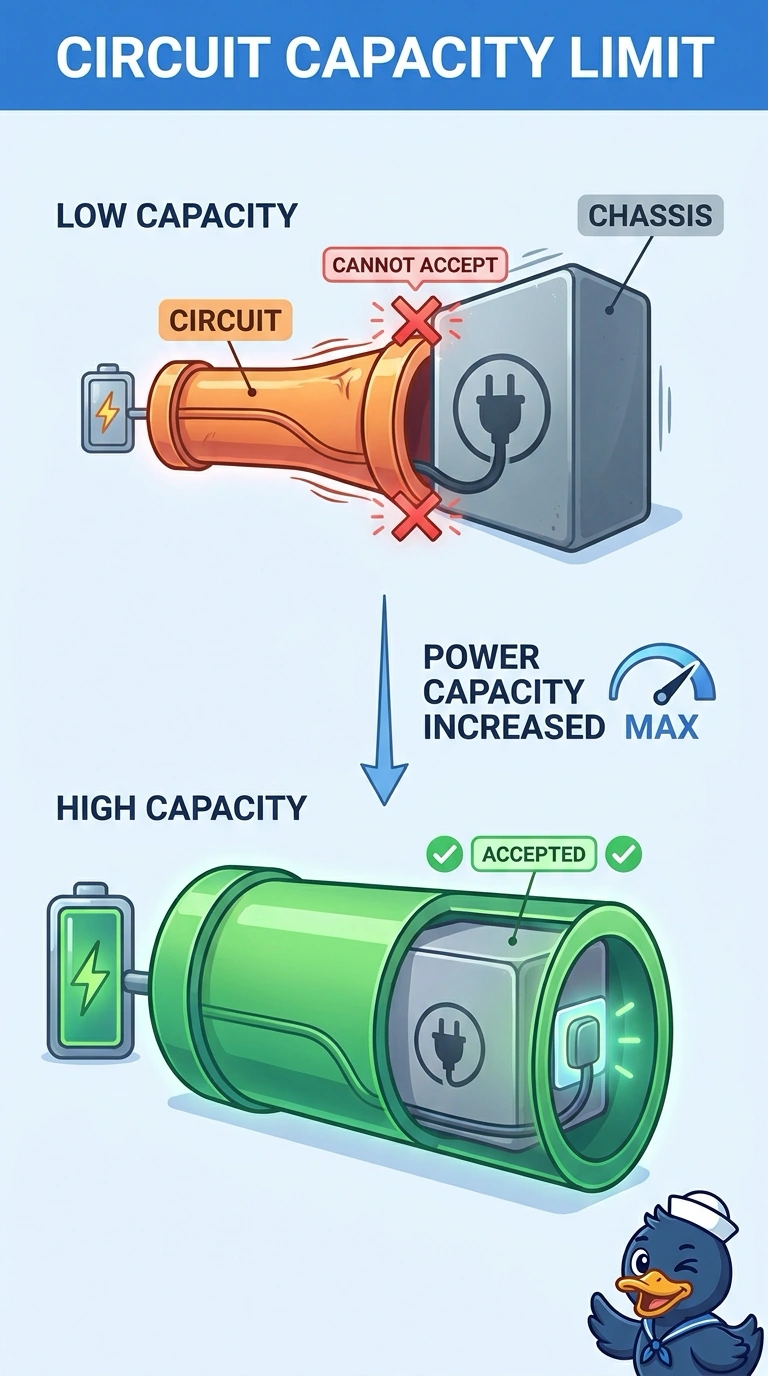
Your PDU meter is a scale, and it shows that the circuit is already near its rated load. You cannot add the chassis until the circuit’s capacity is increased. A rack UPS does not create extra amperes, and two supplies plugged into the same PDU do not split the load across circuits.
Full Explanation
A PDU meter reports how much of the circuit’s rated load is already in use. When the reading is near that rating, there is no meaningful headroom for another chassis, so the chassis cannot be added until circuit capacity is increased. A rack UPS provides backup power during a utility failure; it does not create amperes beyond what the circuit may supply. Treating a near-rating reading as permission to keep adding equipment until the breaker trips mistakes the circuit’s rating for a suggestion, when it is the limit. Plugging both chassis supplies into the same PDU does not split the draw in half: both supplies draw from the same circuit, and the meter reflects their combined load. Exam caveat: count every chassis cord connected to the PDU; redundant supplies on one PDU are not two circuits. Practical check: add the chassis draw to the meter reading, compare the total with the circuit rating, and install only if the total fits or the circuit has been upgraded. Include every power supply the chassis will plug into that PDU.