
A long narrow warehouse aisle needs the radio energy aimed along the aisle rather than sprayed into a nearby office. Which choice fits that coverage goal?
Select an answer to reveal the explanation.
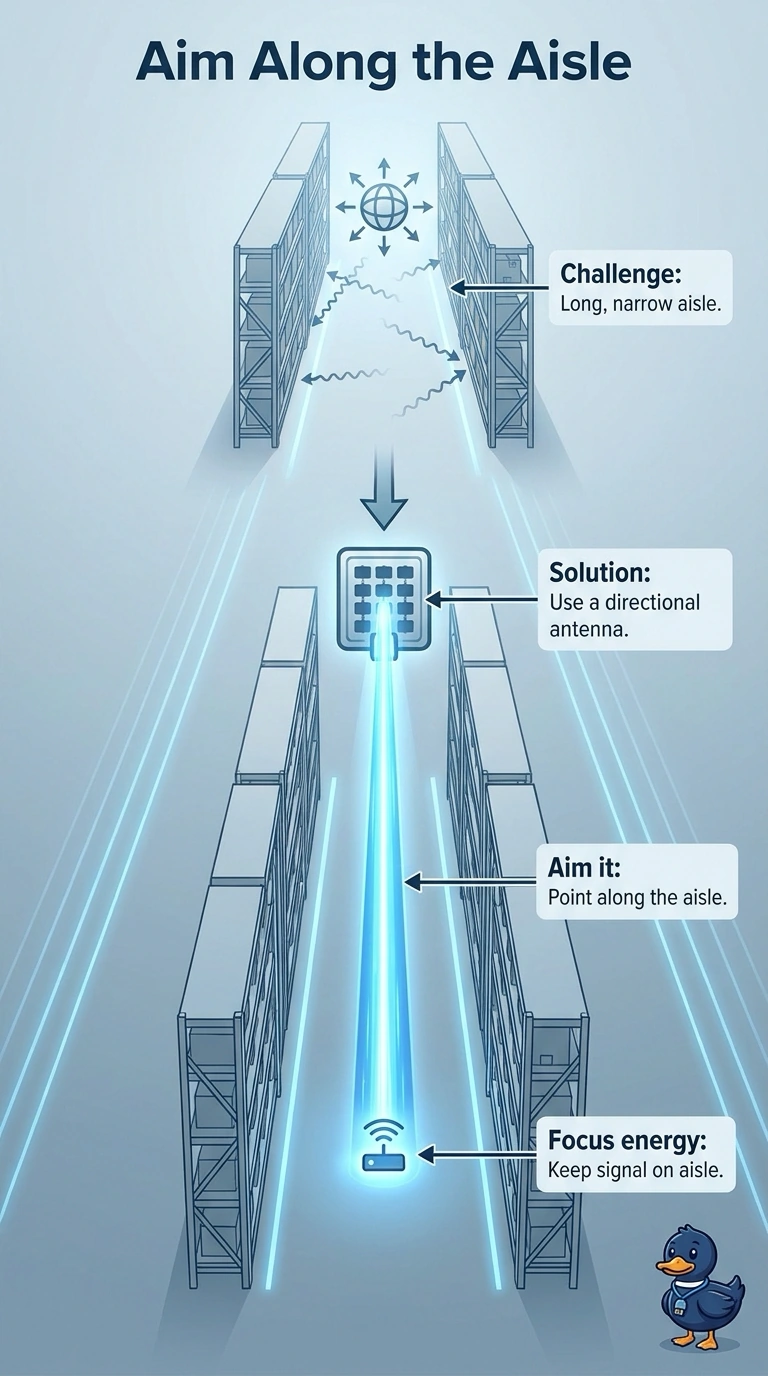
Short Explanation
A directional antenna is a flashlight, and an omnidirectional antenna is a bare bulb. You need the energy aimed down the long aisle, not spilled into the office next door. A louder bulb still shines in every direction, and a flashlight pointed into the office lights the room you were trying to spare.
Full Explanation
A directional antenna concentrates radio energy in a chosen direction and reduces it elsewhere. Aimed along a long narrow aisle, it covers the aisle and limits how much signal sprays into the neighboring office. An omnidirectional antenna in the office radiates roughly equally around itself, so the office is bright and the aisle is a side effect. A higher-gain omnidirectional antenna is the tempting upgrade. More gain stretches the pattern, and an omnidirectional pattern still goes around the radio rather than down the aisle. A directional antenna aimed into the office is the right hardware pointed the wrong way. The aisle then sits behind the pattern the site wanted along the floor. Exam caveat: a directional antenna mounted too high, with a wide vertical lobe, can still light the office. Aim it, then survey. Operational check: survey signal along the aisle and inside the office, confirm usable coverage on the aisle, and confirm the office reading dropped. Repeat the survey at both ends of the aisle, not only at the antenna.