
Servers in a data hall send jumbo frames, while a switch in the middle of the path still allows only the standard 1500-byte payload. Large copies fail, and 200-byte pings succeed. Which change fixes the copies?
Select an answer to reveal the explanation.
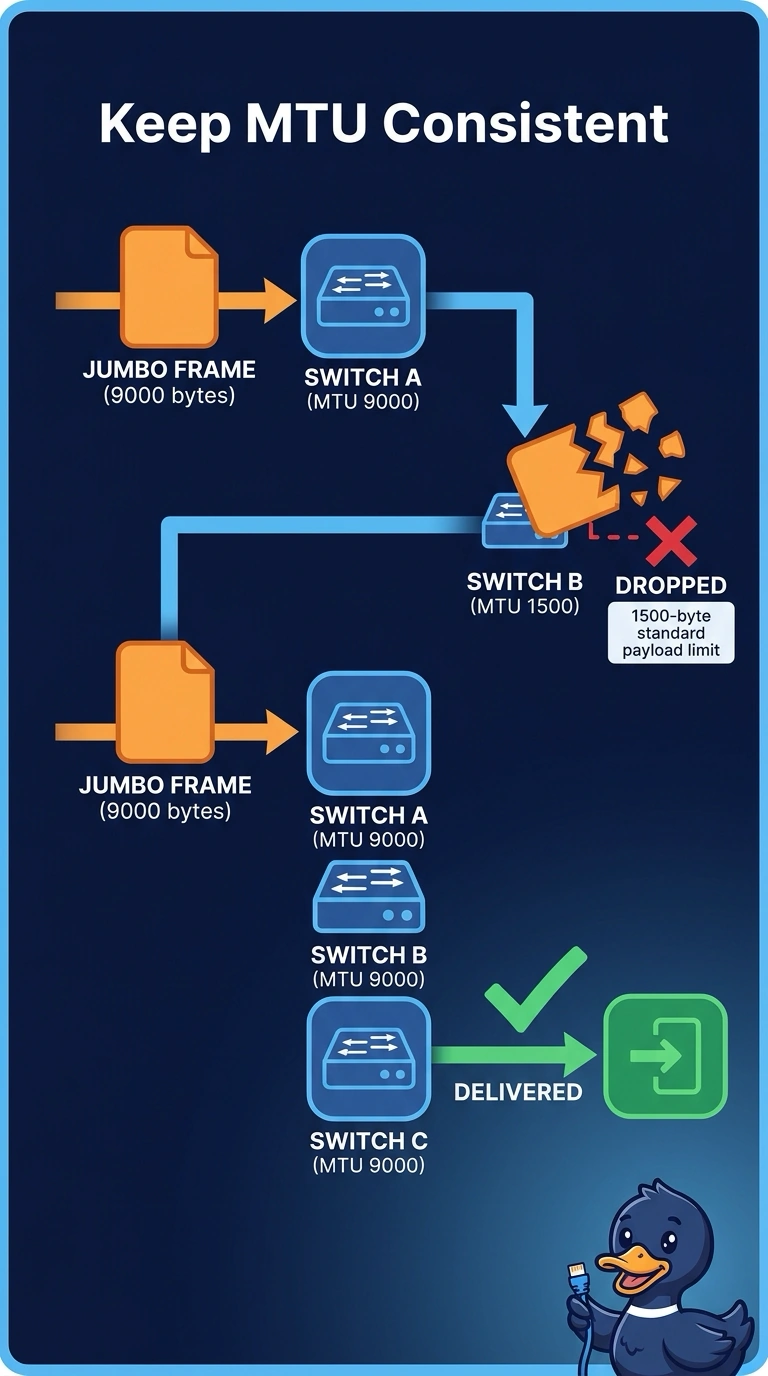
Short Explanation
A jumbo crate does not fit a doorway built for a standard box. Your servers are sending jumbo frames, the middle switch still expects a 1500-byte payload, large copies die, and a 200-byte ping sails through. You make the MTU the same along the path, because a larger server frame or a switch that cannot fragment leaves the doorway at 1500.
Full Explanation
The standard Ethernet payload is 1500 bytes. Jumbo frames are larger, and every hop must accept that size. The servers send jumbos and the middle switch still allows only 1500, so it drops the oversized frames. A 200-byte ping passes and proves the path is up for ordinary frames. The fix is a consistent MTU on the path, either by accepting the jumbo size on the middle switch and the other hops, or by stopping the servers from sending jumbos. Raising only the servers' MTU makes the mismatch worse. The middle switch is the hop that is too small. An Ethernet switch drops an oversized frame. It does not fragment it the way a router may fragment an IP packet. Lowering the ping further changes a test that already succeeds and does not let the large copies through. Exam caveat: one uplink left at 1500 still black-holes the jumbos. Consistency means the whole path. Operational check: after the change, send a ping larger than 1500 bytes with fragmentation disabled, confirm it succeeds, and retry a large copy.