
A small office has no RADIUS server and wants wireless encryption whose personal-mode handshake replaces the older shared-passphrase handshake. Which security mode fits?
Select an answer to reveal the explanation.
Short Explanation
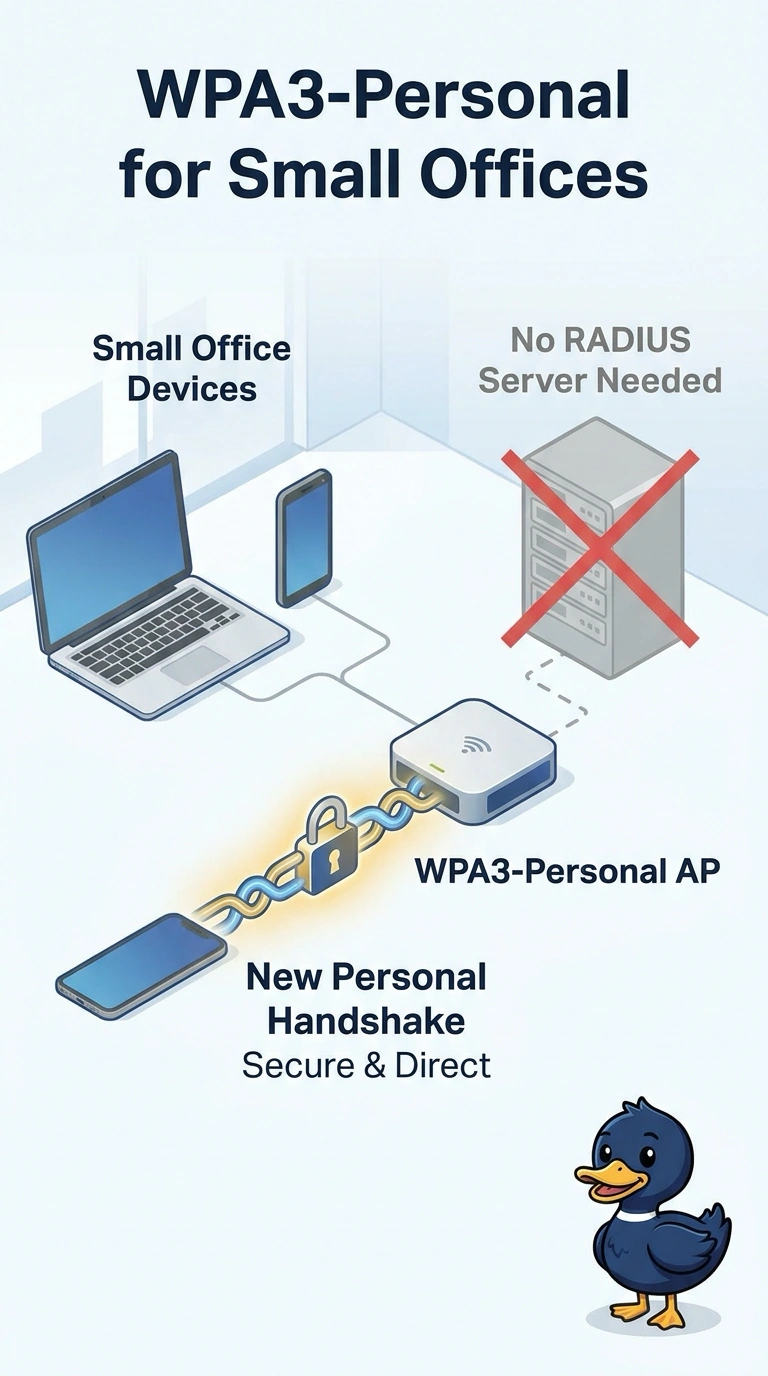
You want a modern personal-mode handshake, and your office does not have a RADIUS server to use for authentication. WPA3-Personal fits because it provides the newer personal handshake without requiring RADIUS. WPA2-Enterprise needs RADIUS, while WEP and an open network would leave you with weaker or no wireless encryption.
Full Explanation
WPA3-Personal replaces the older pre-shared-key handshake used by WPA2-Personal with a newer personal authentication handshake, and it does not require a RADIUS server. Your small office has no RADIUS server and wants to move away from the old shared-passphrase handshake, so WPA3-Personal fits both requirements. WPA2-Enterprise authenticates each user through 802.1X against a RADIUS server. That provides a stronger identity model, but it depends on a server your office does not have, so it fails the stated constraint. Wired Equivalent Privacy is an early wireless security scheme with well-known weaknesses; choosing it would move backward rather than provide a current replacement for the older handshake. An open network with a captive portal may require a browser sign-in, but it provides no wireless encryption, so people within radio range may be able to read wireless traffic. A portal is not a substitute for WPA3 encryption. Exam caveat: personal mode still requires you to distribute and rotate a shared secret; WPA3-Personal improves the handshake but does not provide per-user credentials. Practical check: confirm the access points advertise WPA3-Personal, test that a current client associates and passes traffic, and ensure the network name no longer offers a WEP or open profile.