
Five access points in a warehouse advertise one network name so phones can roam the aisles. Each radio still has its own MAC address. Which identifier stays the same as a phone walks, and which one changes?
Select an answer to reveal the explanation.
Short Explanation
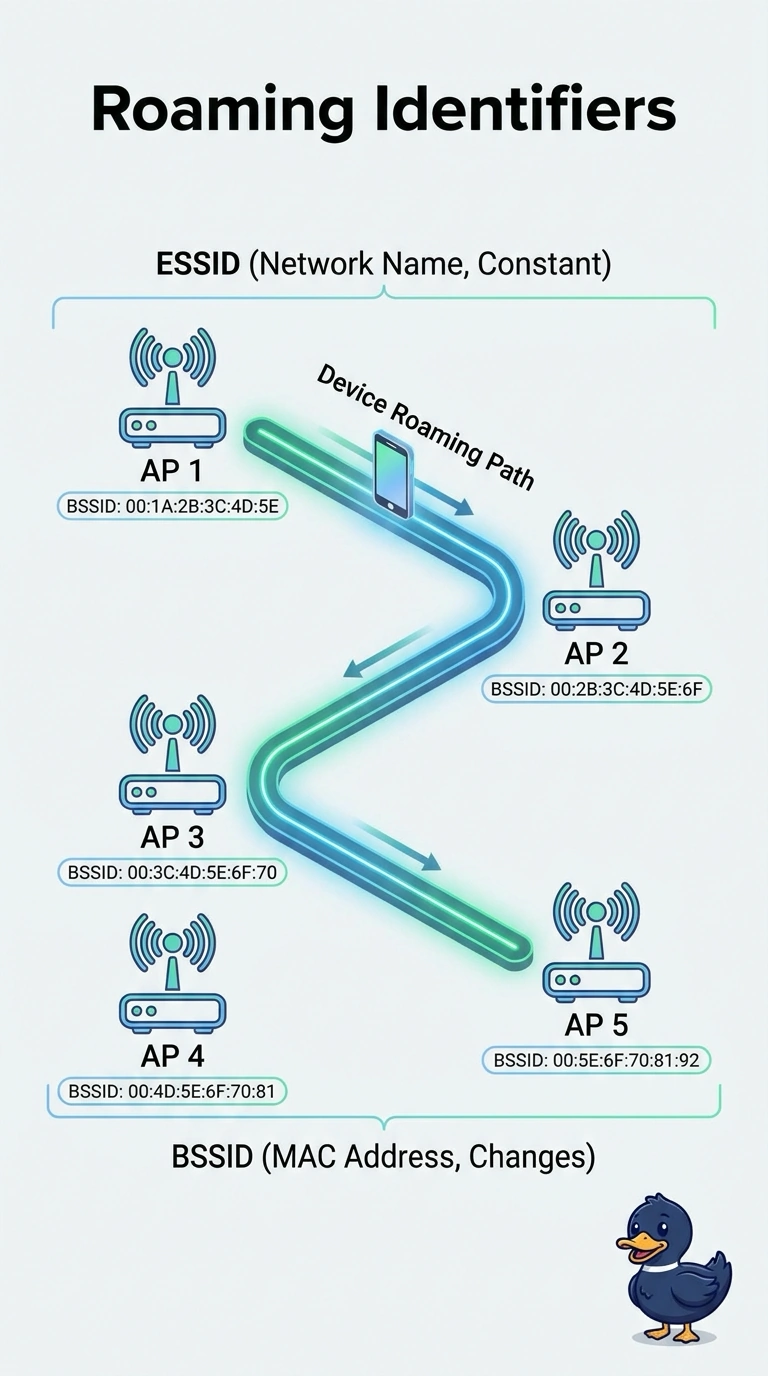
The painted name on five storefronts can match while each door still has its own address. You keep joining the same ESSID, the shared network name, and the BSSID, which is that radio's MAC address, changes as the phone walks to the next access point. Do not swap those two, and do not treat the name as a channel number.
Full Explanation
An extended service set lets several access points advertise one wireless name so a client can roam without the user picking a new network. That shared name is the ESSID. Each radio still owns a basic service set, and the identifier of that radio is the BSSID, which is the radio's MAC address. As the phone moves down the aisle it keeps the ESSID and associates to a new BSSID. Swapping the two names reverses the observation: the MAC changes, the advertised name does not. The ESSID is not a channel number. Channel selection is a separate radio setting, and two radios can share a name while using different channels, or the same channel, without renaming the network. Roaming does not require every radio to pretend to be the same MAC. Clients use the changing BSSID to tell the radios apart while the name the user recognizes stays constant. Exam caveat: people often say SSID for the name users see. On a multi-access-point network that shared name is the ESSID, and each BSS still has its own BSSID. Operational check: stand near one radio, note the ESSID and the BSSID the phone is associated to, walk to the next radio, and confirm the name is unchanged while the BSSID matches the second radio's MAC address.