
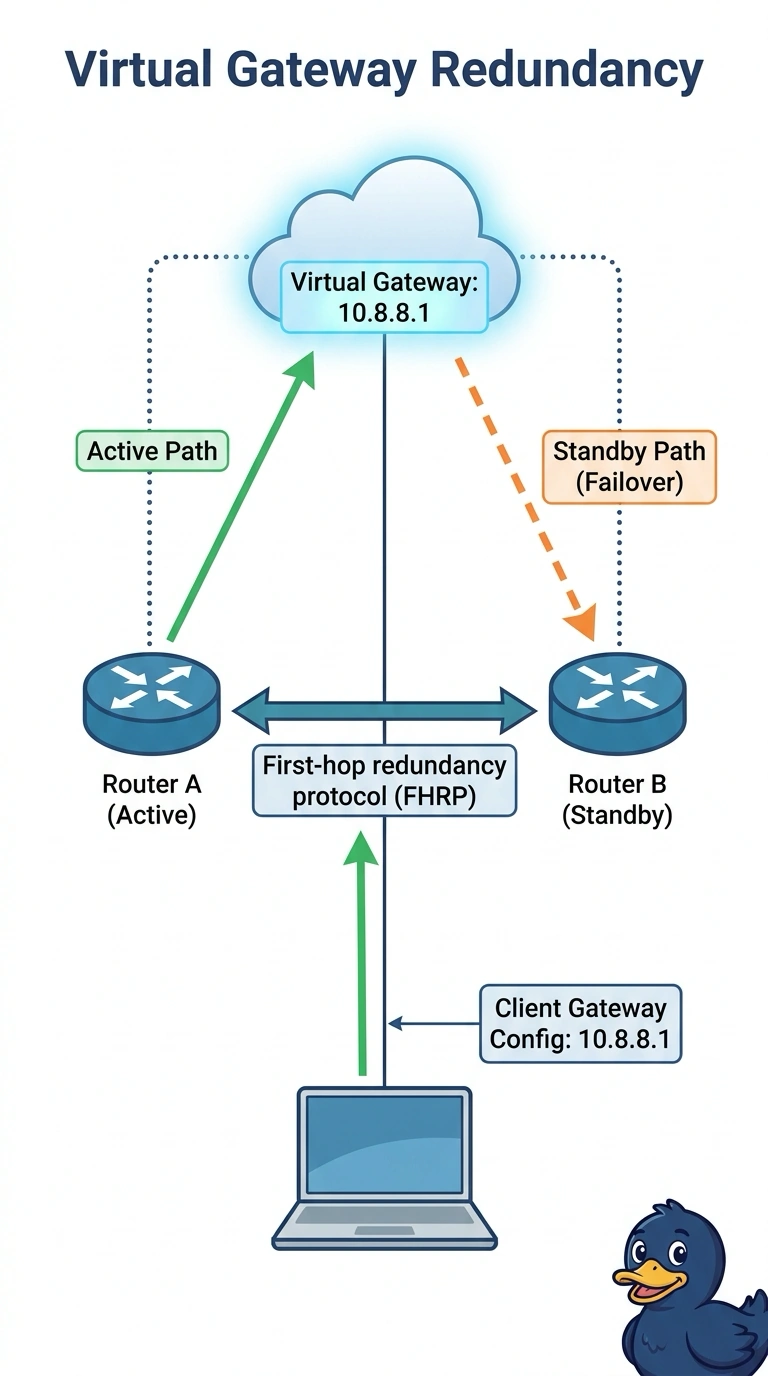
Hosts on a factory LAN use 10.8.8.1 as their gateway. That address is not a physical interface on either router. When router A is powered off, router B starts answering for 10.8.8.1 and the hosts keep working. Which feature is this?
Select an answer to reveal the explanation.
Short Explanation
The address your PCs use as the front door does not have to live on one box forever. A first-hop redundancy protocol lets two routers share that virtual IP, and the survivor picks it up when the other one dies, so your hosts never learn a new gateway. The hosts are not rewriting their own routes, and the address is not a physical interface on either router.
Full Explanation
A first-hop redundancy protocol gives hosts a single gateway address that two or more routers cooperate to own. Only the active router answers for the virtual IP. If it fails, the standby router takes over that address and the hosts keep using the same gateway, which is what happened when router A was powered off and router B began answering for 10.8.8.1. The address is virtual, so it is not a physical interface on either router. A second default route that hosts install by themselves would require every host to notice the failure and change its own table. These hosts kept the same gateway, and nothing says they installed a new route. Configuring the same physical address on both routers is the tempting reading of a shared gateway, and the stem says 10.8.8.1 is not a physical interface. Two live routers with one physical address would conflict rather than hand off cleanly. A routing protocol can advertise a loopback, and a loopback with the same address on both routers is a conflict, not a coordinated virtual gateway, unless a first-hop protocol is orchestrating it. Exam caveat: the virtual IP must be in the hosts' subnet and must be the gateway they are actually configured to use. A standby router that owns a virtual address nobody points at does not help. Operational check: fail router A in a maintenance window and confirm router B owns 10.8.8.1, that hosts still use that gateway, and that the address returns to router A when it recovers.