
Two distribution switches have two parallel cables between them. The designer wants both cables forwarding and wants traffic to survive if one cable is unplugged. Which feature should be configured on the pair?
Select an answer to reveal the explanation.
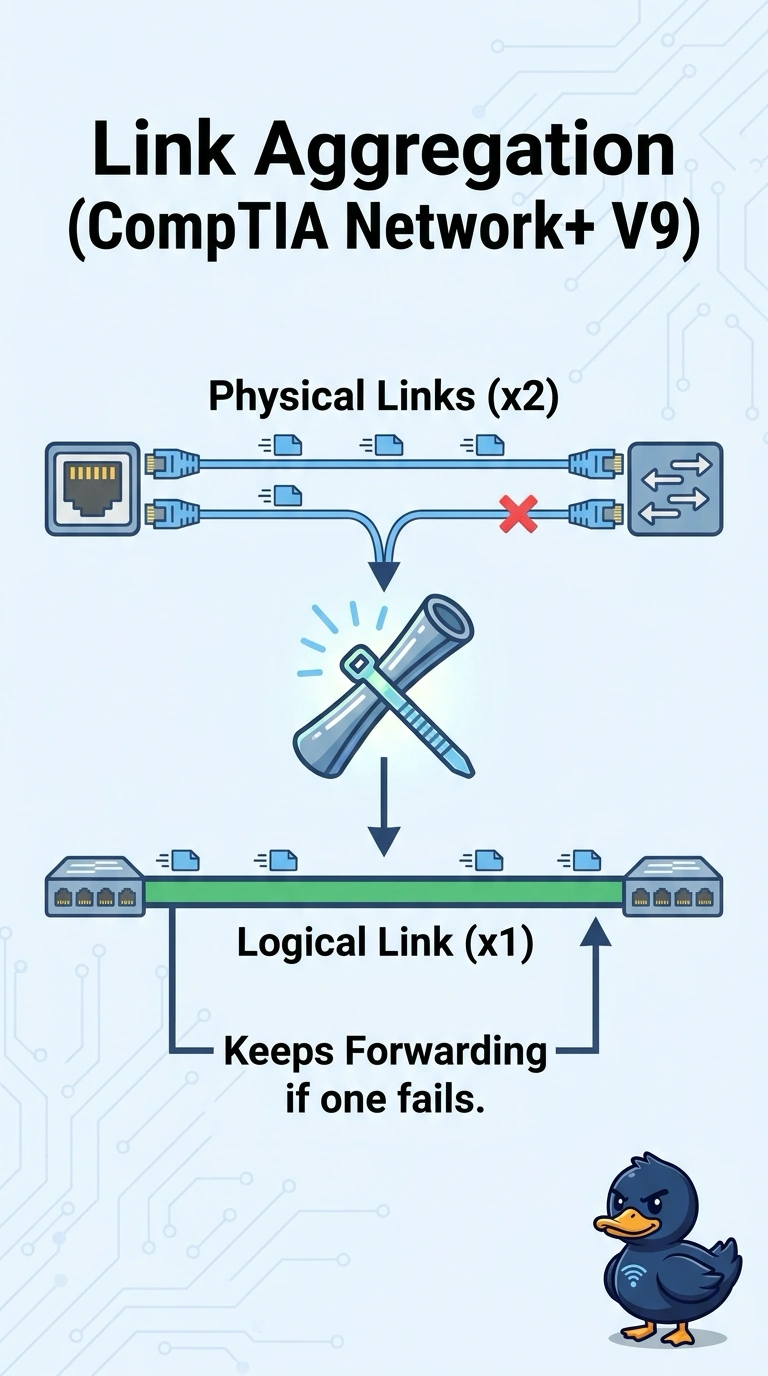
Short Explanation
Two roads between the same towns do you no good if the traffic rules close one of them. Link aggregation treats the two cables as one road with two lanes, so both carry traffic and either lane can fail without closing the trip. Spanning tree, even the rapid kind, still shuts one of two parallel links to stop a loop.
Full Explanation
Link aggregation combines parallel links between the same pair of devices into one logical link. Both members can forward, and the logical link stays up if one member fails, which is the survival the designer asked for. The switches have to agree on the bundle, and the member ports have to match. Spanning tree sees two parallel layer-2 paths as a loop and blocks one of them. That prevents a broadcast storm, and it leaves one cable idle, so it fails the request that both cables forward. Rapid spanning tree is the tempting upgrade, because it converges faster, and it still blocks one of the two links. Speed of convergence does not make both cables active. Two independent trunks look like redundancy, and without a bundle the protocol treats them as a loop and blocks one. The loop exists because both cables connect the same two switches, not because they were bundled. Bundling is what lets both forward. Exam caveat: a single flow is usually pinned to one member by a hash. Aggregation raises total capacity and survivability, and it does not make one large transfer run faster than a single cable. Operational check: shut one member and confirm the logical link stays up, traffic continues, and the remaining member is forwarding, then restore the member and confirm both are in the bundle.