
A stub branch office has one router and one path to headquarters. The staff do not want a routing protocol running on that single link. Which design fits the office?
Select an answer to reveal the explanation.
Short Explanation
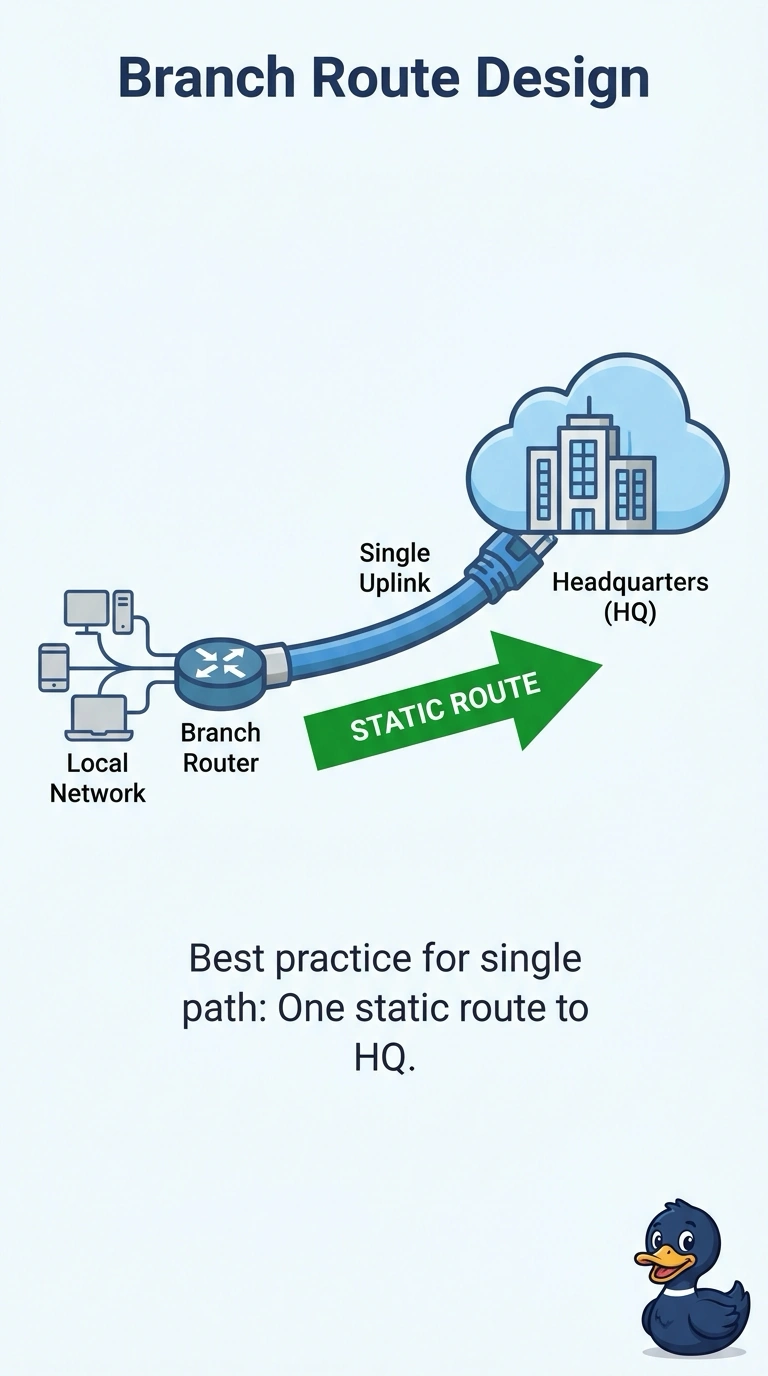
When there is only one road out of town, you do not need a committee to pick it. You put a static route on the branch router toward headquarters and leave a routing protocol off that single link. A floating route with nothing to float to, a virtual address with nobody to fail over to, and an area design for one hop are extra machinery.
Full Explanation
A static route is an entry an administrator writes, pointing a destination prefix at a next hop. The office has one router and exactly one path to headquarters, and the staff do not want a routing protocol on that link. A static route toward headquarters across the uplink sends internal traffic there without neighbor discovery or an area design. A floating static route is the tempting extra. It is still a static route, and it exists to take over when a preferred route disappears. With one uplink there is no second path to float to, so the float does not match the design. A first-hop redundancy protocol offers hosts a virtual gateway shared by two or more routers. With only one router there is no second device to assume the address, and it is not a route to headquarters. OSPF would be a routing protocol on the link, which is what the staff refused for a single hop. Exam caveat: headquarters may still learn the branch prefix by a static route on the headquarters side. That choice does not force a protocol onto the branch router. Operational check: confirm the branch table has a static route for the headquarters destinations via the uplink next hop, confirm no routing-protocol neighbor is up on that link, and ping a headquarters host from the branch LAN.