
Two access switches trunk several VLANs, but devices on the untagged VLAN can reach the wrong subnet whenever traffic crosses the trunk. Tagged VLANs on the same trunk behave normally. Which trunk setting is mismatched?
Select an answer to reveal the explanation.
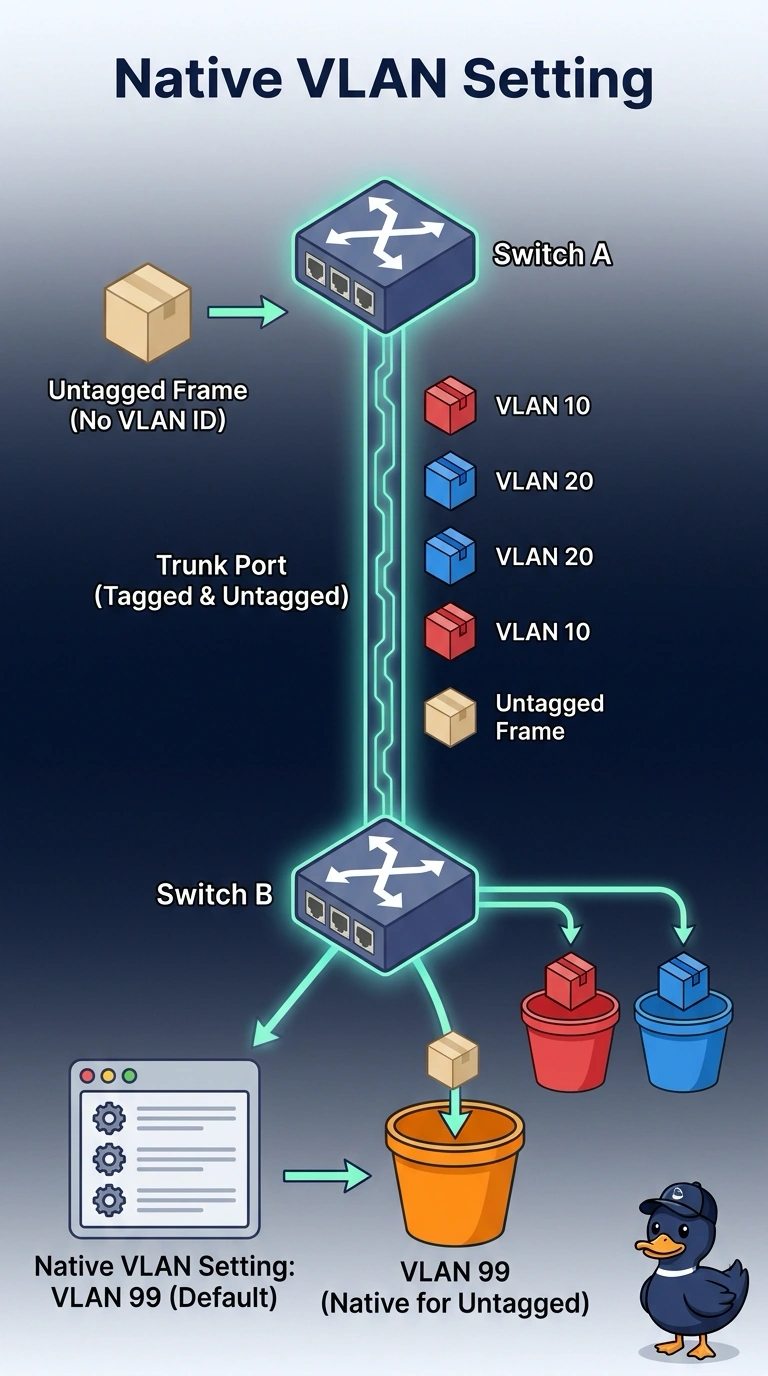
Short Explanation
On a trunk, tagged frames wear a name tag and untagged frames do not. You and the switch on the other side have to agree which VLAN those nameless frames belong to, and that agreement is the native VLAN. If you disagree, the untagged traffic walks into the wrong room while every tagged VLAN still looks fine.
Full Explanation
IEEE 802.1Q carries a VLAN identifier in a tag. Frames that belong to the trunk's native VLAN are sent without that tag. The receiving switch places every untagged frame into whatever VLAN it is using as native. When the two ends disagree, a frame that left in one VLAN arrives in another, so devices on the untagged VLAN cross into the wrong subnet. Tagged VLANs are unaffected because their identifiers travel in the tag. That split, tagged good and untagged wrong, is the signature of a native VLAN mismatch. A voice VLAN is the tempting neighbor: it also separates one class of traffic from another, and it does that on an access port for a phone, not by classifying untagged frames on a switch-to-switch trunk. An allowed-VLAN list can drop a VLAN, and the stem says the tagged VLANs still pass, so the list is not what moved only the untagged traffic. Disabling 802.1Q on one end would stop those tagged VLANs, which is the opposite of the symptom. Exam caveat: some designs tag the native VLAN on purpose so that no user traffic is untagged. Both ends must still agree. Operational check: compare the native VLAN on both ends of the trunk and confirm untagged frames captured on one side appear in the same VLAN on the other.