
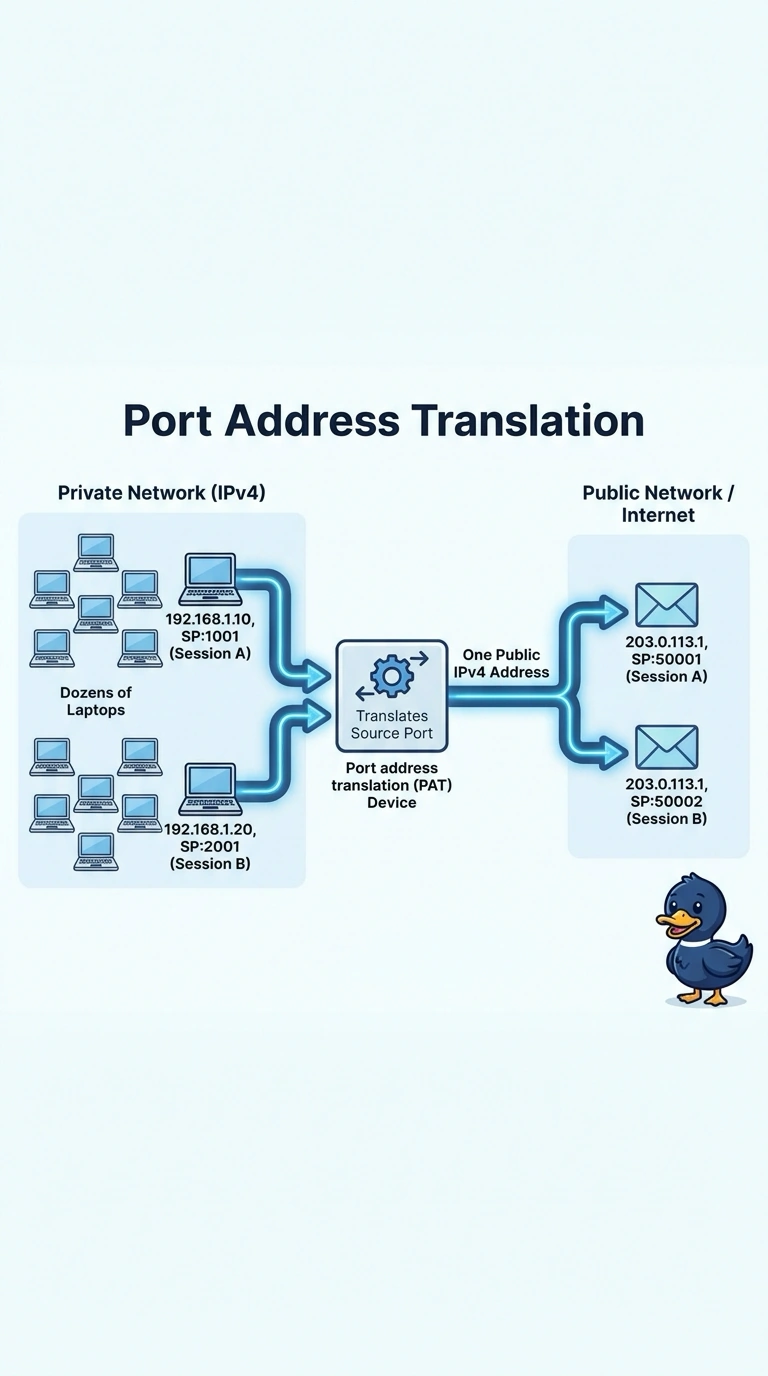
A retail shop has one public IPv4 address, and dozens of laptops browse at the same time. The firewall rewrites each private source address to that public address and tracks a different source port for every session. Which translation is this?
Select an answer to reveal the explanation.
Short Explanation
You have one public street number and a lobby full of people who all need mail sent out under that number. Port address translation keeps them apart by writing a different source port on each session. One-to-one NAT, or a pool with one public address per laptop, would demand addresses you do not have.
Full Explanation
Port address translation, also called NAT overload, rewrites many private source addresses to a single public address and uses a unique source port to tell the sessions apart. When the reply returns to that public address and port, the firewall's translation table restores the original private host and port. The shop has one public address and many simultaneous browsers, and the firewall is tracking a different source port per session, so this is port address translation. One-to-one NAT maps a single private address to a single public address. Dozens of laptops would need dozens of public addresses, which the shop does not have. A public pool with one address per laptop is the same shortage stated as a pool: one public address cannot be divided into one address per laptop. Static NAT publishes one inside server on a fixed public mapping. It does not create a source-port entry for every browsing session from every laptop. That option looks right because the firewall is translating, and the stem's per-session ports are the detail that makes it overload rather than a single published host. Exam caveat: a firewall can publish one server with static NAT and overload everyone else with port address translation. Seeing one static rule does not name the laptop translations. Operational check: open the translation table during a busy period and confirm many private addresses share the one public address, distinguished by source port.