
A media newsroom wants software to mark the people, cities, and company names inside articles so editors can link those mentions. The desk does not need a score for whether the article praises or criticizes its subject. Which task fits?
Select an answer to reveal the explanation.
Short Explanation
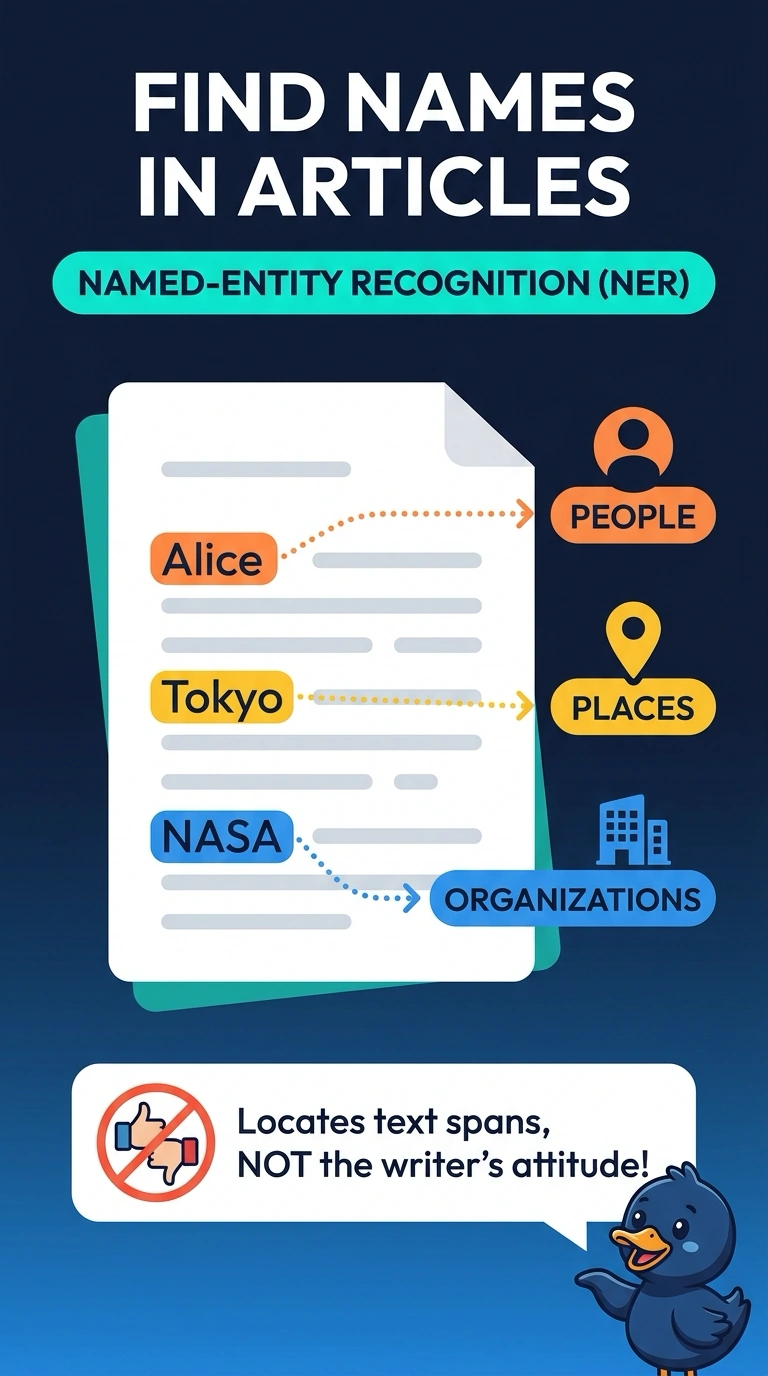
A name in a sentence is like a luggage tag on a bag: it tells you who or where, not whether the trip was pleasant. Named-entity recognition marks those people, places, and organizations. Don't grab a mood label when the editors asked for the tags.
Full Explanation
Named-entity recognition scans text for spans that refer to particular kinds of things, commonly people, places, and organizations, and marks those spans so a downstream step can link them. The newsroom asked for exactly that markup on people, cities, and company names, and it explicitly set attitude scoring aside. The model does not have to decide whether the article is favorable. It has to find the mentions. Sentiment classification assigns an attitude label such as positive, negative, or mixed, which answers a question the desk said it does not need. Topic modeling clusters documents into themes and does not draw boundaries around a name inside a sentence. Stemming chops or maps words to crude roots so that variants collide, and a root is not a person, a city, or a company. Exam caveat: entity types vary by project, so a tag set that includes titles or products is still named-entity recognition when the job is span labeling rather than attitude. Operational check: review a sample of tagged articles and confirm each highlight is a mention boundary with an entity type, not a document-level mood score.