
A mobile carrier offers only one handset-repair option and asks for a multi-armed bandit that will explore alternatives. No other repair option exists. Why does that request fail?
Select an answer to reveal the explanation.
Short Explanation
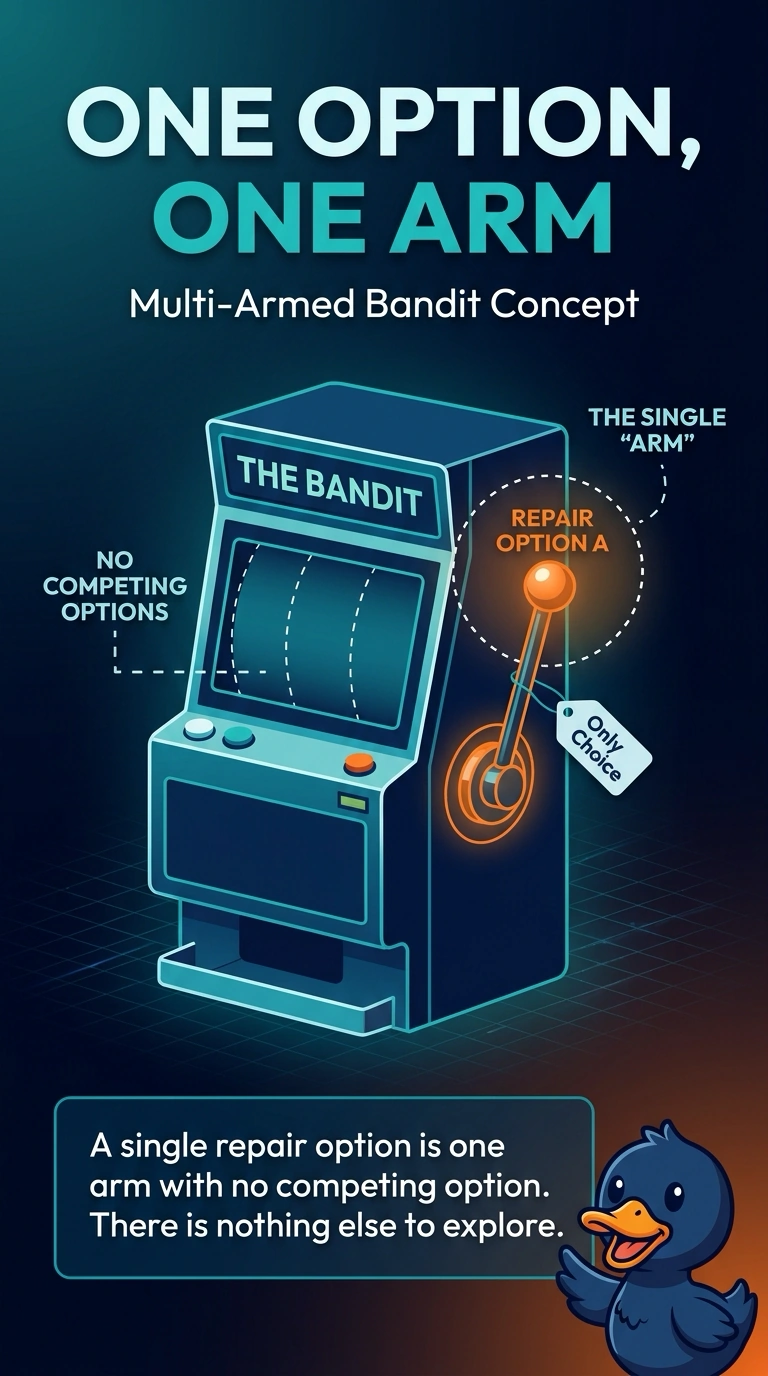
You need competing arms for a bandit to explore: with just one repair option, there is no alternative to try against it. The reward need not be known in advance or continuous, and equal numbers of trials are not required; the problem is that no competing repair option exists.
Full Explanation
A multi-armed bandit chooses among arms while learning their rewards, directing some trials to uncertain arms and more trials to the arm that currently looks best. With only one handset-repair option, there is no second arm to try, so the explore-versus-use comparison has nothing to compare. The request fails because a single arm leaves no competing repair option to explore. The reward need not be known in full before the first customer: a bandit learns rewards while acting, so a short history does not prevent it from starting. Nor must the reward be continuous; a completed-or-not repair result is a usable two-outcome reward that a bandit can learn from. Finally, equal numbers of trials across arms are not required by every bandit rule. A single arm does not fail because an equal-pull quota is impossible; it fails because there is no alternative repair option to try. Exam caveat: treating repair versus not offering repair as two actions would create a second arm, but that is a different decision from exploring among repair options when only one exists. Practical check: list the repair options the policy can assign; if the list contains only one, there is no bandit exploration among repair options.