
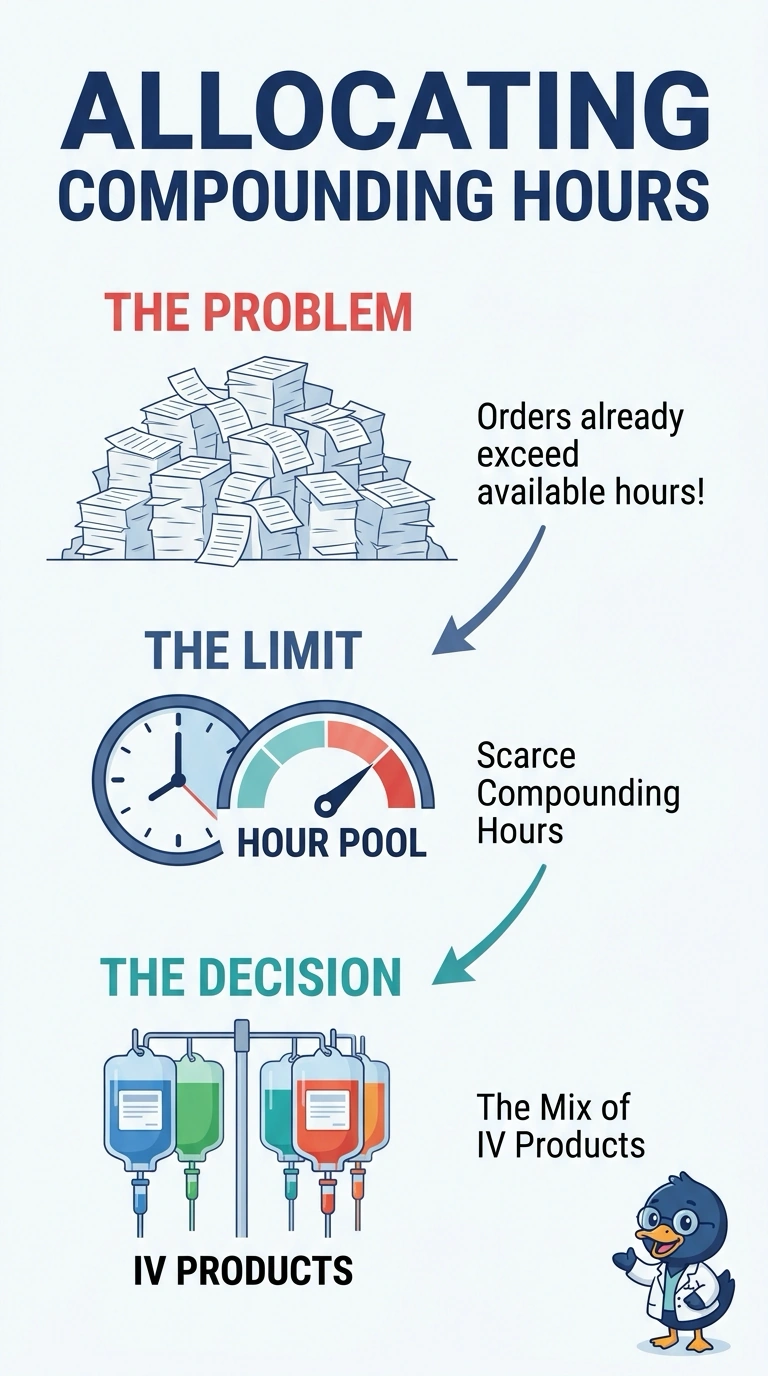
A hospital pharmacy has a fixed pool of sterile-compounding hours this week and must decide how many units of each IV product to make. Orders already exceed those hours. Which problem is the pharmacy solving?
Select an answer to reveal the explanation.
Short Explanation
You only have so many hours in the compounding room, and every bag of one drug is an hour you cannot give another drug. That shortage is a constrained allocation, not a forecast or a label. The trap is reaching for a prediction tool when the decision is how to split a limit you already have.
Full Explanation
The pharmacy already knows that orders exceed a fixed pool of sterile-compounding hours, and the decision is how many units of each IV product to make inside that limit. That is an allocation of a scarce input: the hours are the constraint, and the product mix is the set of decision quantities. Clustering would group products by similarity so a representative could stand in for a group, but it would not decide production quantities under an hour cap. Forecasting next week's orders is a different job that estimates demand before a production decision; here the overrun is already known, and the open question is how to spend the hours. Classification would assign each product a label such as urgent or routine, which does not by itself choose how many units to compound when the hour pool cannot cover every order. Exam caveat: a demand forecast can be an input to a later allocation, but feeding a forecast is not the same problem as splitting a known scarce resource. Operational check: write the decision as quantities of each IV product and write the compounding hours as a limit those quantities must respect.