
A media company's viewing records must remain inside one country. Its contract forbids copying that store into a foreign region or into a vendor cloud the company does not control. Which deployment keeps the records inside that boundary?
Select an answer to reveal the explanation.
Short Explanation
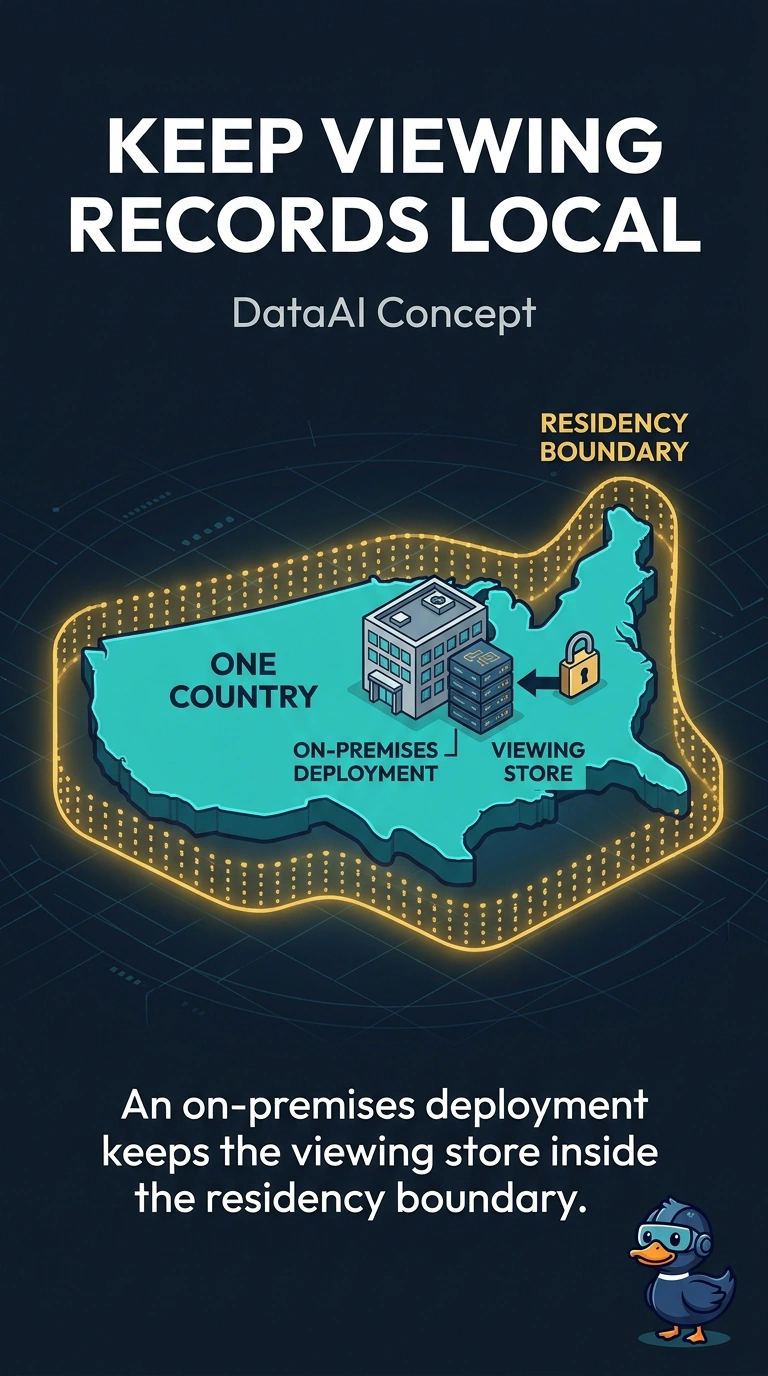
If the records are not allowed to cross the border, the machines that hold them have to stay on your side of it. You keep the viewing store on premises, inside the residency boundary the team cannot move. The trap is a foreign region or a hybrid that still ships a copy out.
Full Explanation
The contract is a location rule: the viewing store cannot be copied into a foreign region or into a vendor cloud the company does not control. An on-premises deployment keeps that store inside the residency boundary the team is not allowed to move. A cloud region in another country, even one that grows for premiere week and shrinks later, still depends on the forbidden copy. Home players that each hold the full warehouse place copies on devices the company does not control. A hybrid that trains in a foreign cloud on a copied store moves the records across the boundary even if the resulting scores are later used by an in-country service. A premiere-week burst does not relax the contract, because a temporary foreign copy is still a copy. Exam caveat: on-premises placement answers this residency rule; it does not by itself supply extra capacity for premiere week. Operational check: list every replica and backup of the viewing store, including standby copies held for recovery, and confirm each one stays inside the country and on systems the company controls.