
A media company is training a subtitle model whose weights and batch will not fit on the largest single server it can obtain. The job has to occupy many machines at the same time, not one machine that grows for a while and is later removed. Which deployment matches that limit?
Select an answer to reveal the explanation.
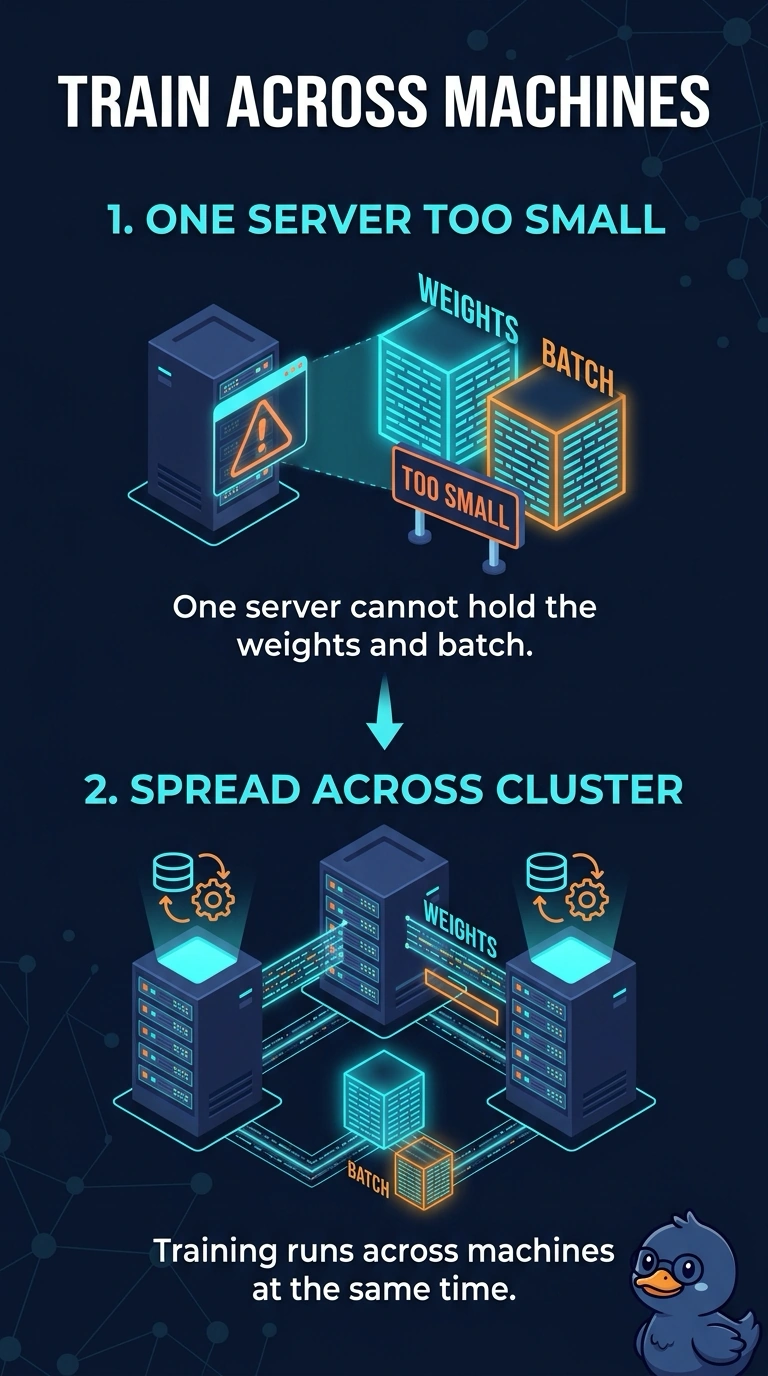
Short Explanation
When the weights will not fit on one server, wishing for a single taller box misses the limit you were given. You spread the training job across a cluster of machines that work at the same time. The trap is a cloud pattern that only swaps in one bigger machine and takes it away later.
Full Explanation
A cluster spreads one training job across machines so the weights and the batch can reside on the group at the same time. The stem states that even the largest single server the company can obtain cannot hold this subtitle model, and that the job must occupy many machines together rather than one machine that grows and is later removed. A desk-side edge device is built for a small power and memory budget at one workstation, which is the opposite of a fit that already exceeds the largest server. Substituting one bigger cloud machine, then removing it, changes the size of a single machine over time, and a single machine still cannot hold the job. An on-premises workstation that keeps the footage in the building still trains on one device, which the memory limit rules out. Exam caveat: growing and shrinking one machine is a different property from a cluster that has to occupy many machines at once. Operational check: confirm the training run is scheduled on several machines together and that a one-server launch was rejected because the weights and the batch do not fit.