
A telecom team finds that one tower's overnight signal feed is shifted low on every row, while three other towers each have a single garbled row and the rest of the rows look normal. How should the two problems be described?
Select an answer to reveal the explanation.
Short Explanation
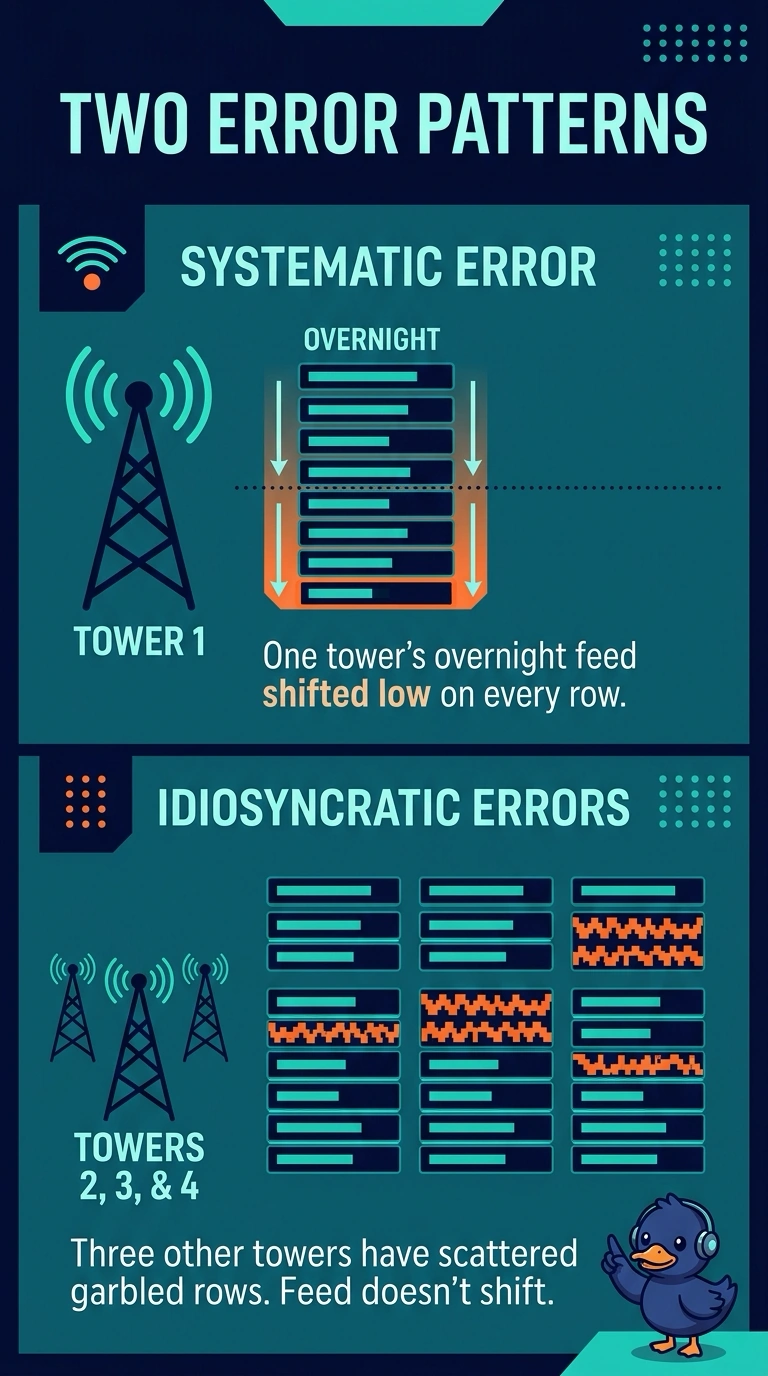
One clock that runs slow all night is a different problem from a few smudged digits on other clocks. The tower-wide shift is systematic, and the scattered garbled rows are idiosyncratic. Do not give both problems the same name just because they showed up in your overnight file.
Full Explanation
A systematic error belongs to a source and shows up across that source's rows, such as one tower whose overnight feed sits low on every reading. An idiosyncratic error is local to scattered rows, such as a single garbled record on an otherwise normal tower. The stem has one of each: a source-wide shift, and isolated bad rows that do not move their towers. Calling both systematic treats every bad cell as a source failure and erases the difference between a moved feed and a one-off garble. Calling both idiosyncratic ignores that every row from the shifted tower is low, which is a source pattern rather than a scattered accident. Swapping the names assigns the source-wide shift to isolated noise and treats the scattered garbles as the source pattern, which reverses the evidence. Exam caveat: a systematic problem can be an offset, a scale error, or a repeated bad code, as long as it attaches to the source rather than to isolated rows. Operational check: group rows by tower, compare each tower's center with the others, and separate a moved center from rows that are wild only one at a time.