
A bank fraud model is dominated by a few genuine but enormous transfer amounts. The team wants to keep every account row and cap those amounts at a high cutoff. Which treatment is that?
Select an answer to reveal the explanation.
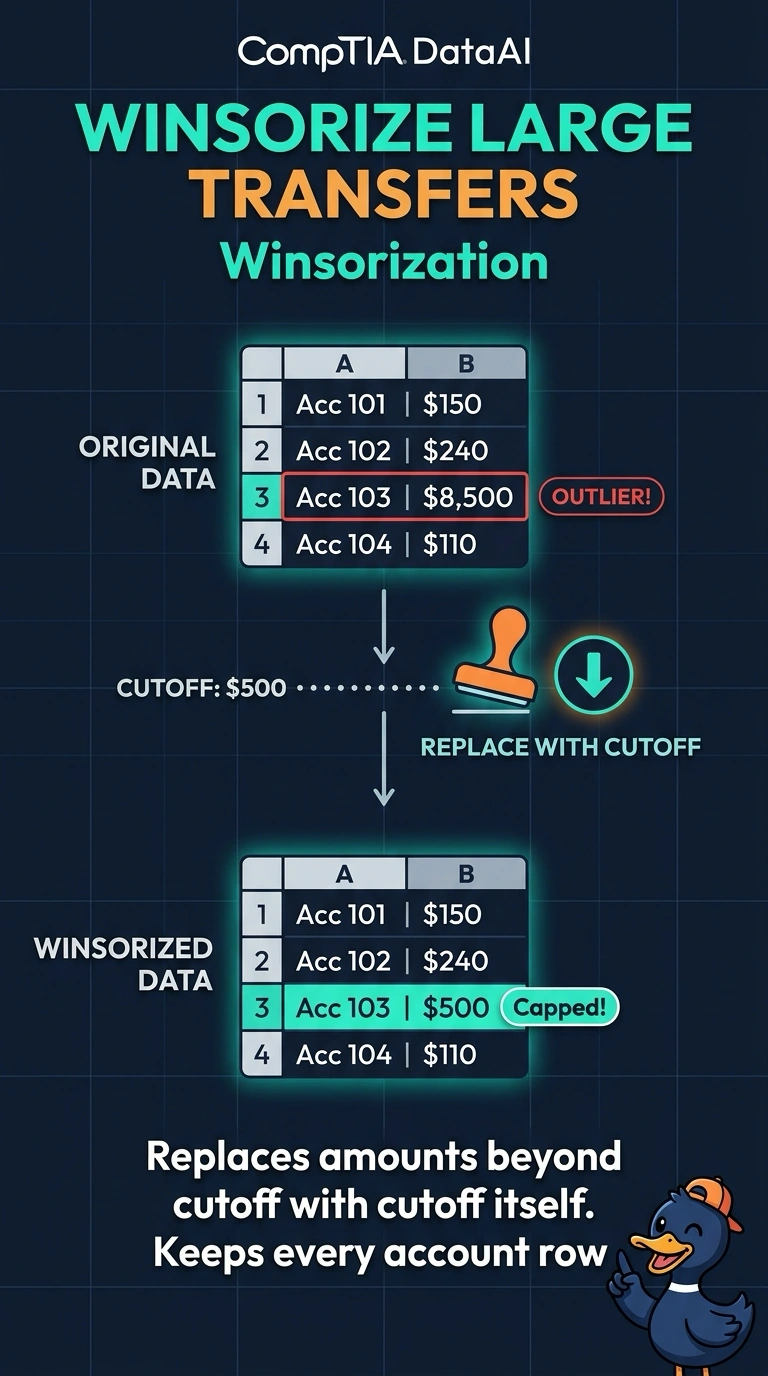
Short Explanation
Fold the tallest posts down to a cap rail and you keep the fence standing. Winsorization caps those extreme transfers at a cutoff and keeps the account row. Deleting the row, or rescaling every transfer by the same factor, is a different job.
Full Explanation
Winsorization keeps every row and replaces a value past a chosen cutoff with that cutoff. The extreme transfer no longer pulls the fit without bound, and the account's other fields stay in the file, which is what the fraud team asked for. Deleting the account removes the row rather than capping the amount, so the other fields on that account disappear with the extreme. Multiplying every transfer by the same constant rescales the column and preserves rank order, but it does not pin the largest amounts to a cutoff. Substituting the column mean for the extremes is a different replacement: the new value is the mean, not the cutoff the team chose, so it is not winsorization. The cutoff is a point on the transfer scale, and every amount past it is rewritten to that point while the account's other fields stay available for the fraud model. A later review can still see that the account existed and that its amount was limited. Exam caveat: trimming, which drops the extreme rows, is easy to confuse with winsorization, which keeps the rows and only caps the values. Operational check: after the treatment, confirm the account count is unchanged and that no transfer sits beyond the cutoff the team declared.