
A bank plans to ship a scoring library inside a mobile app that customers install. The library's license forbids redistributing it inside a product the bank gives to customers. What does that license do to the plan?
Select an answer to reveal the explanation.
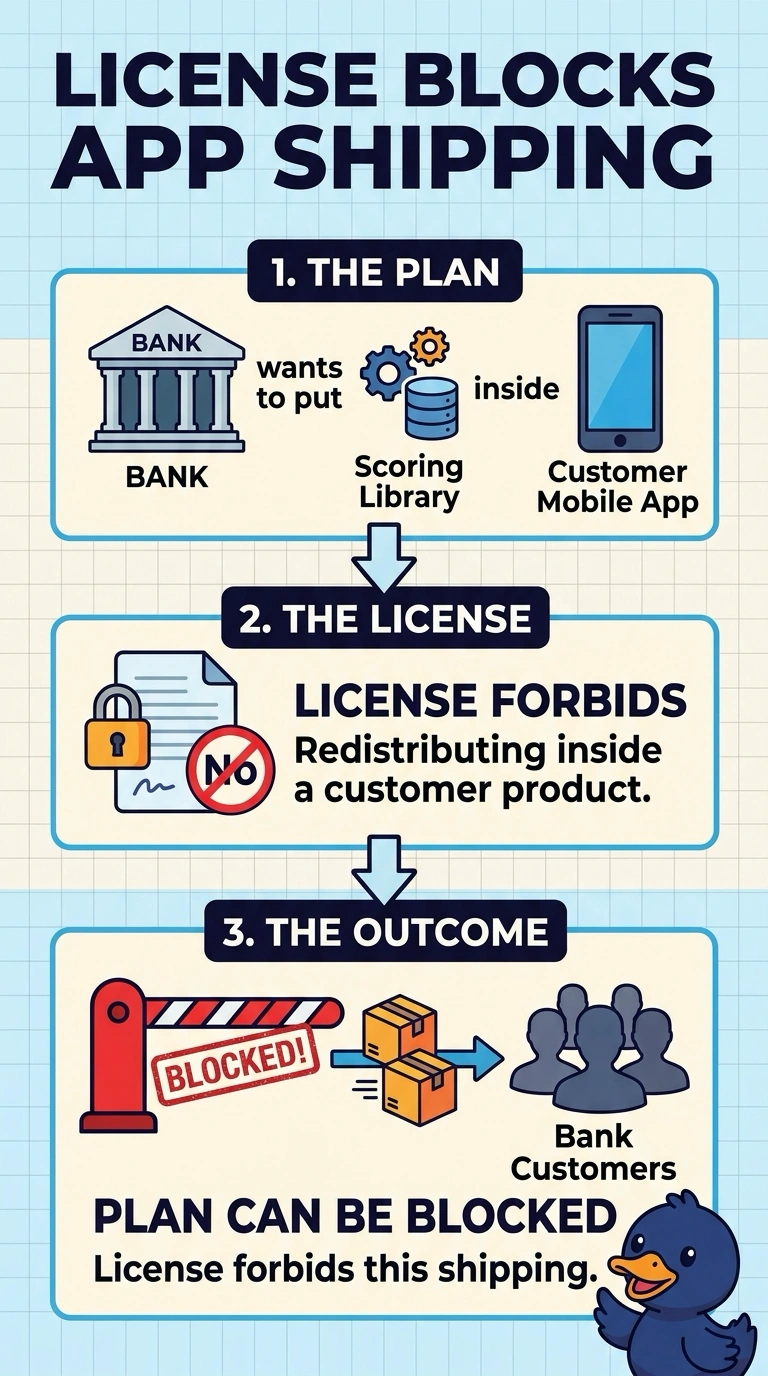
Short Explanation
A license is a gate, and you need to check whether your shipping plan is allowed through. These terms forbid putting the library inside the customer app, so the license can block that plan. Treating a license as a citation rule misses the restriction that matters here.
Full Explanation
A dependency license states what the team may do with the library, including whether it may be redistributed. This license forbids putting the library inside a product given to customers, and the bank plans to ship it inside the customer app, so the license can block the plan. A citation rule for research papers would not govern redistribution; the stated license term does. Requiring the training rows to be published in the download invents an obligation that the stated term does not impose. A cap on how long the build system may spend fitting the model is a pipeline setting, not a term of the library’s license. The plan and the license grant must be read together: the app distributes the library to customers, while the grant forbids that kind of redistribution. That conflict can block shipment regardless of the scorer’s accuracy. Citation practices, publishing training rows, and build-time limits are different controls not stated in this restriction. Exam caveat: another library under a different license might allow this shipment, so the conclusion follows from the specific restriction here, not merely from the existence of a license. Practical check: read the redistribution clause and confirm that it forbids inclusion in a customer app before linking the library into the build.