
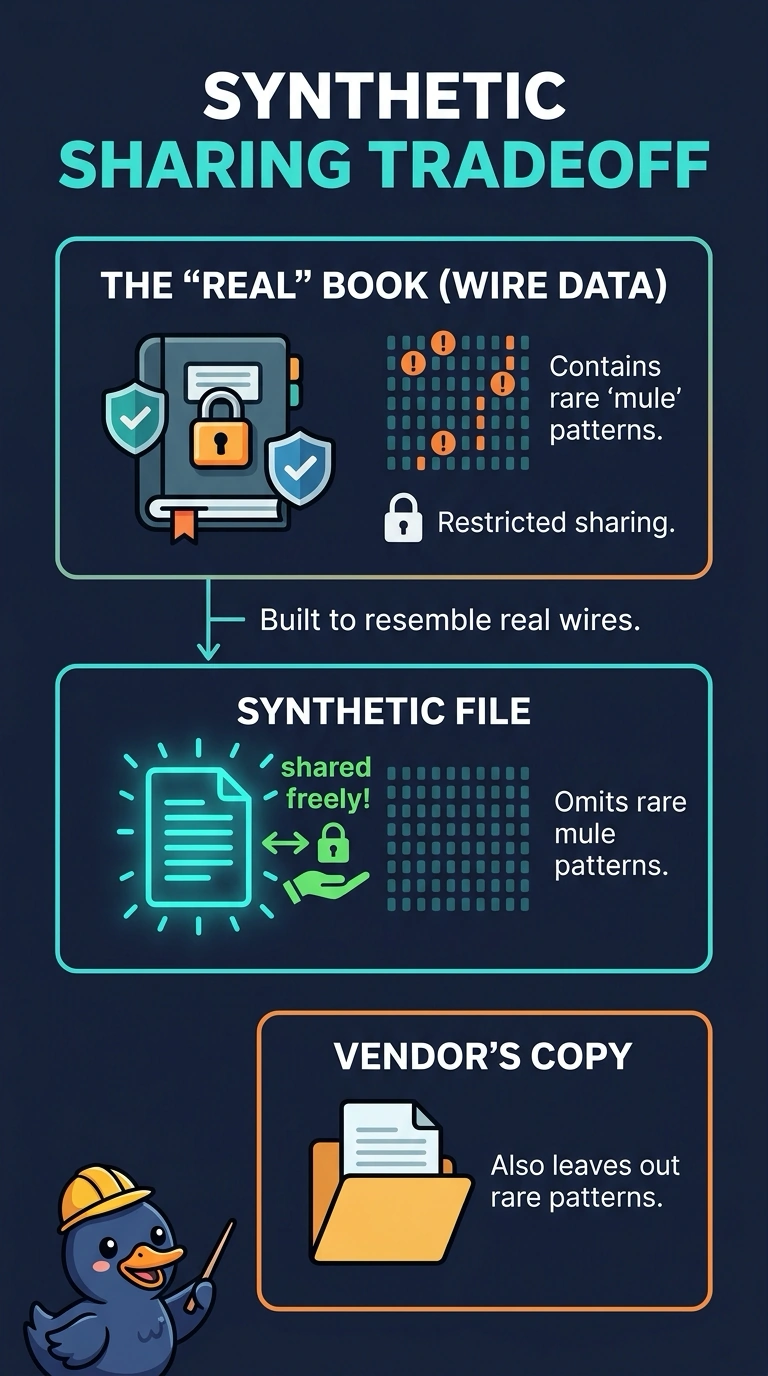
A bank will not ship real wire-transfer rows to an outside modeler, so it shares a synthetic set built to resemble those wires. The vendor can take the synthetic file under a lighter review. Rare mule patterns that show up only occasionally in the real book are absent from the file. What tradeoff did the bank accept?
Select an answer to reveal the explanation.
Short Explanation
A practice drill can be shown to visitors and still leave out the rare event you actually fear. You can hand the vendor a synthetic wire file under a lighter review than real customer rows. The trap is assuming that easier sharing means every rare mule pattern survived.
Full Explanation
Synthetic data are generated to resemble real records without shipping those records. That is why the bank can share the file under a lighter review than real wire rows, which carry customer activity the bank will not release. Generation can still miss patterns that are rare in the real book. The mule behavior that appears only occasionally was not carried into the file, so the vendor is studying a world where that behavior is absent. The tradeoff is easier sharing together with an incomplete picture of rare real patterns. The claim that sharing is easier because every rare pattern was preserved reverses the stem. The file is easier to share because it is not the real rows, and the rare patterns were left out. Calling the file an administrative extract mistakes generated rows for tables collected to run the wire desk. Administrative data come from operating a process. These rows were built to resemble that process for sharing. Calling the file a randomized trial mistakes synthesis for assignment. Nobody was allocated to a mule treatment. The patterns are missing because the generator did not reproduce them, not because a trial was underpowered. Exam caveat: matching typical amounts and common channels does not prove that rare joint patterns survived. Operational check: inside the bank, list the rare mule patterns in the real book and confirm each one has a counterpart in the synthetic file before the vendor treats the file as complete.