
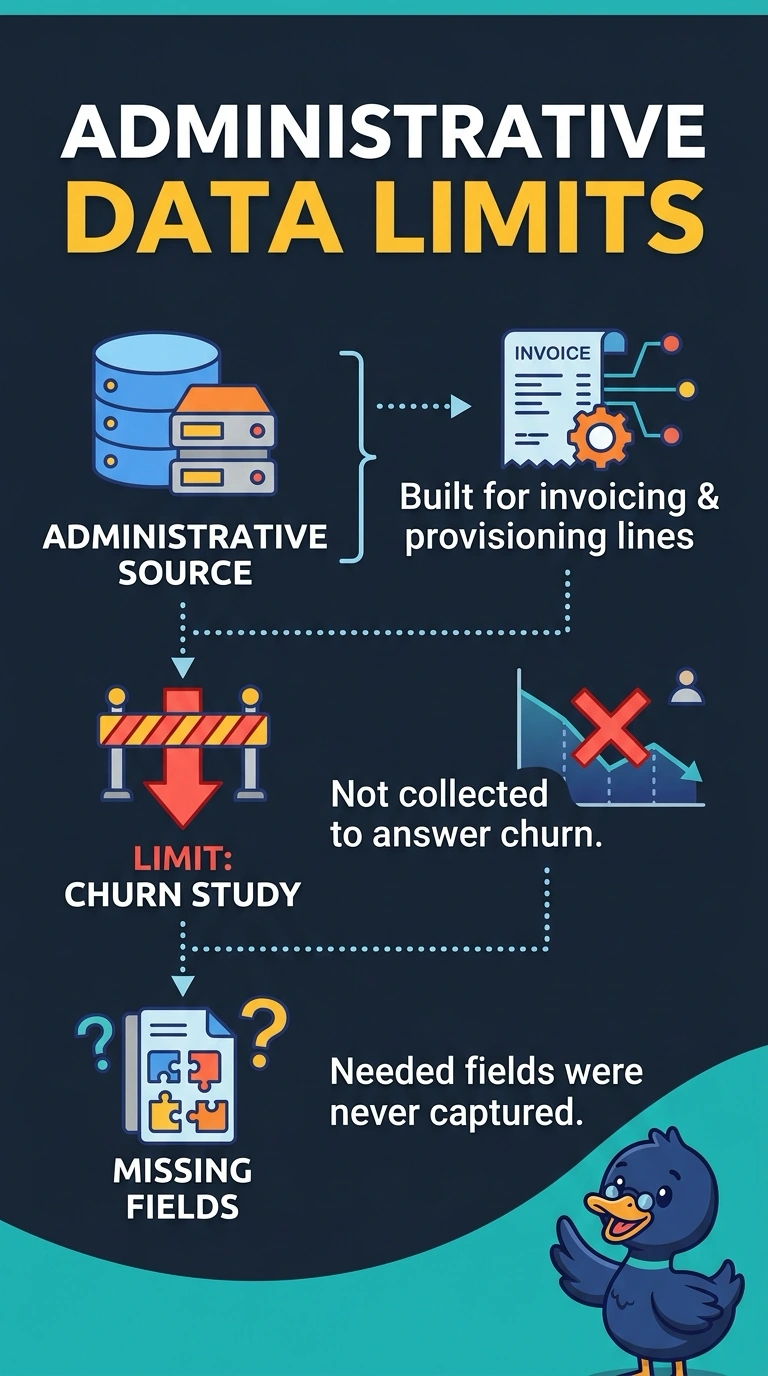
A telecom analyst studies why customers leave by reusing the billing system's service-change tables. Those tables were built so the company could invoice and provision lines, and several fields the study needs were never captured. What kind of source is this, and what limit comes with it?
Select an answer to reveal the explanation.
Short Explanation
A cash-register tape was printed to run the store, not to answer your research question. You are reusing billing tables that were captured so the company could invoice and provision lines. The trap is treating that operational completeness as if the fields had been designed for the churn study.
Full Explanation
Administrative records are collected to operate a program. Billing and provisioning tables exist so the telecom company can invoice customers and turn services on or off. When those tables are reused for a churn study, their fields, timing, and definitions follow the operational process. Fields the study needs may never have been captured because operations did not need them. That is the limit that comes with this source. The tables are not a randomized experiment. Nobody assigned cancellation as a treatment for the study. The billing system recorded events it needed in order to run. They are not a synthetic ledger either. The rows describe real subscribers and real service changes, even though the capture was designed for billing. They are not a public archive with a reuse license. They are internal operational data, and the limit in the stem is missing study fields, not a public-license clause. Exam caveat: administrative data can still be the right source for an operational question. The caution is to judge fitness for the question at hand, because completeness for billing is not completeness for research. Operational check: read the data dictionary for why each field is captured, and list the churn factors the study needs that the billing tables never stored.