
A mobile carrier trains a deep network whose runtime is dominated by large matrix multiplications over many examples. The lab can add hardware for that training job. Which addition matches the workload?
Select an answer to reveal the explanation.
Short Explanation
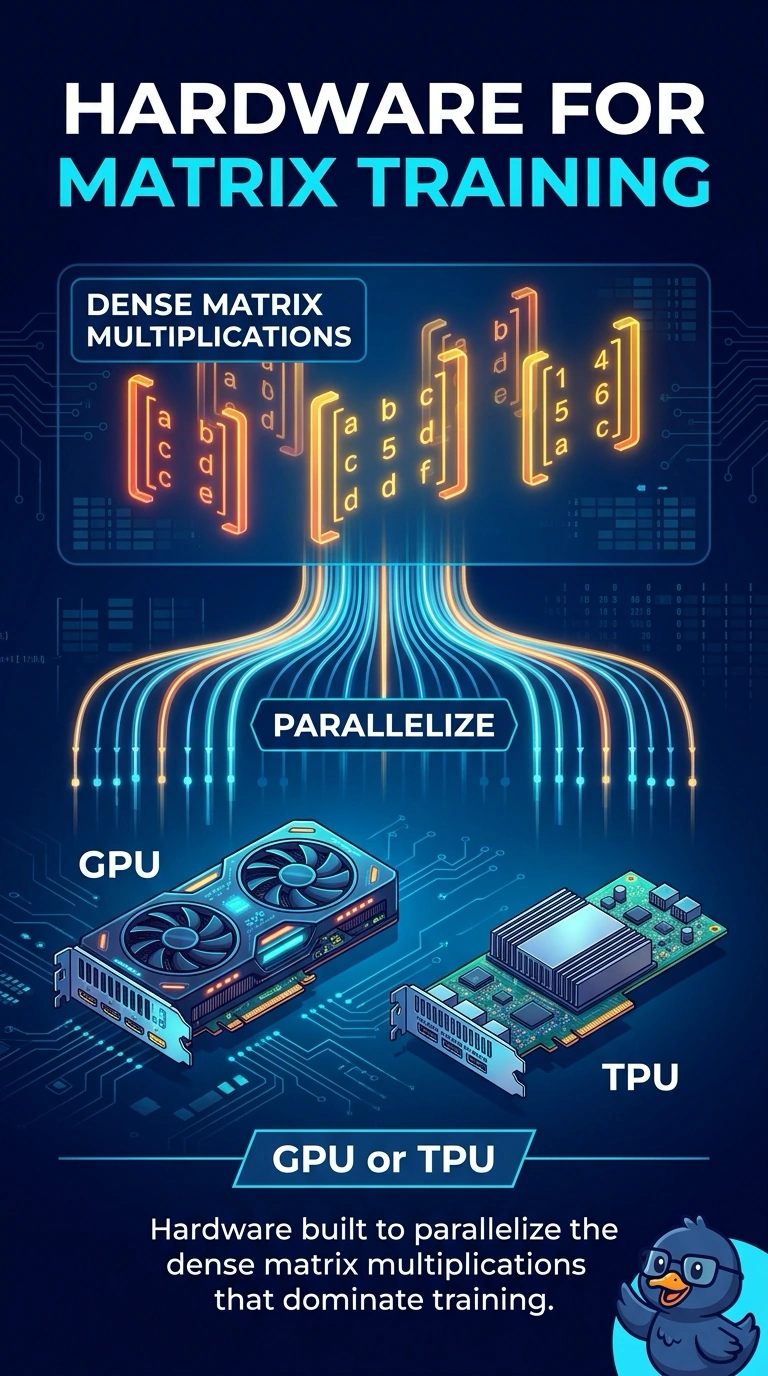
Matrix-heavy training is like a room full of multiplication tables, and you want the hardware that loves that chore. A GPU or TPU runs those dense products in parallel, which is the workload this lab actually has. The trap is buying a fatter storage pipe, which helps files land and does not multiply the matrices.
Full Explanation
Training dominated by large matrix multiplications spends its time on dense linear algebra repeated across many examples. Graphics processors and tensor processors are built to run those products in parallel, so a GPU or TPU matches the mobile carrier's training job. A wider pipe into object storage shortens the wait to land raw capture files, which helps an ingest bottleneck and does not execute the training multiplications. A faster bus for live scoring events improves the path that labels one production call and leaves the offline training kernels untouched. Extra memory on the scheduler that only launches jobs can help queue bookkeeping, while the matrix work still runs on whatever device the scheduler assigned, with no new parallel arithmetic. The right addition is hardware that performs the arithmetic this job actually spends its time on, not a faster pipe for some other stage. Exam caveat: a tiny model or a batch that never fills the device can sit idle on an accelerator, so the hardware win assumes the job really is large matrix work. Operational check: profile one training step and confirm the time sits in large matrix kernels before renting a GPU or TPU.