
An agency must give a partner an extract of grant records. The partner missed the meeting where field meanings, units, and collection rules were explained. What has to travel with the rows so the partner can use the extract correctly?
Select an answer to reveal the explanation.
Short Explanation
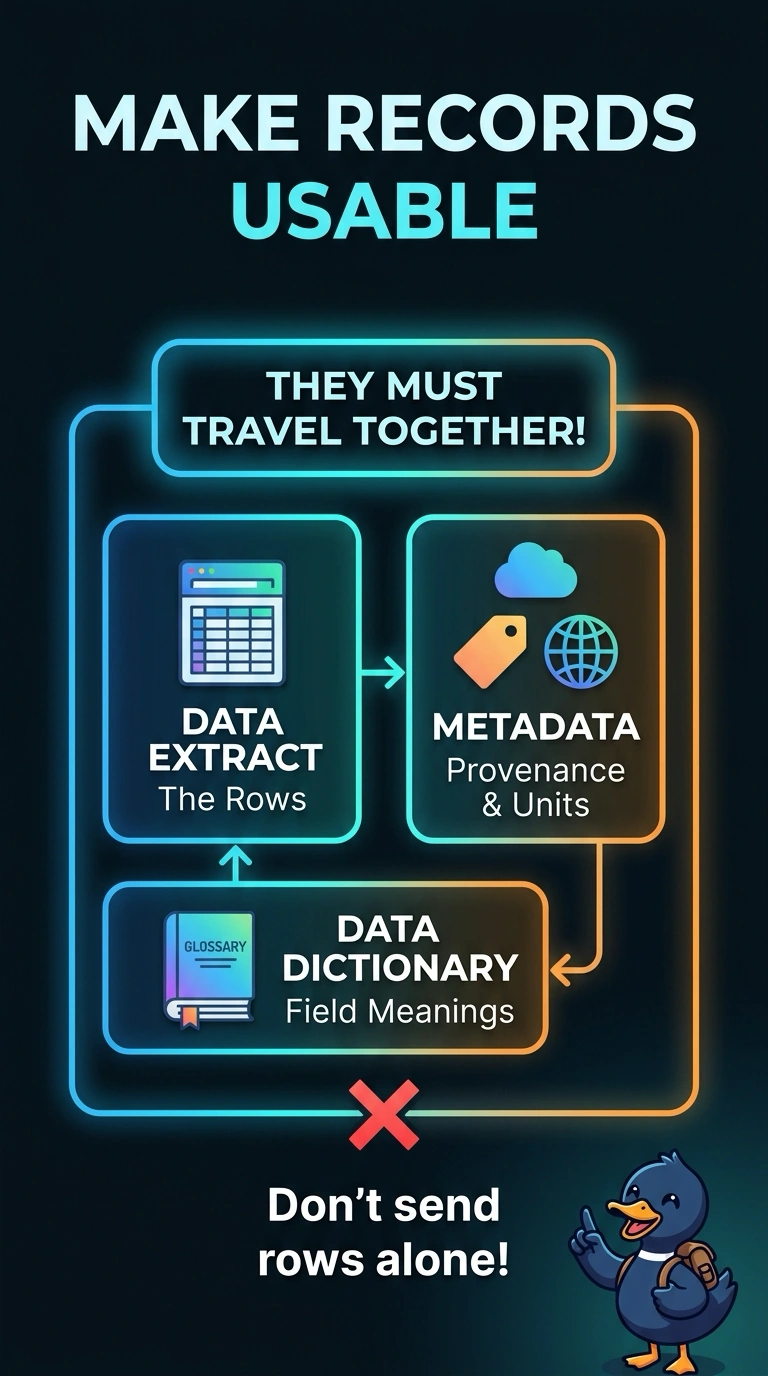
A box of unlabeled keys is what you hand over when the rows travel alone. You send the extract with metadata and a dictionary, not the rows by themselves. The trap is a note about last month's model that still leaves every field undefined.
Full Explanation
A partner who missed the definitions can use the extract only if the meanings, units, and collection rules travel with the rows. Metadata and a data dictionary are that accompaniment; the extract alone is not. Sending the rows by themselves leaves the partner to guess from headers and from patterns in the values, which drops the explanations given in the meeting. A note that names which scoring model changed last month records a model delta and, as described, attaches no field meanings, units, or collection rules. A screenshot of an internal chart shows a picture and omits the table, the field list, and any statement of where the rows came from. Exam caveat: a column header is a name, not a definition of units or of the collection rule behind the values. A partner who can see the numbers still cannot tell whether a blank means zero, unknown, or not collected unless that rule travels with the rows. Operational check: give the package to a colleague who missed the meeting and confirm they can state one field's meaning, its units, and where the rows came from using only what was sent.