
A bank fraud team sees accuracy stay high because almost every card transaction is legitimate, while a missed fraud costs far more than a false alarm an analyst reviews. How should the team choose between candidate models?
Select an answer to reveal the explanation.
Short Explanation
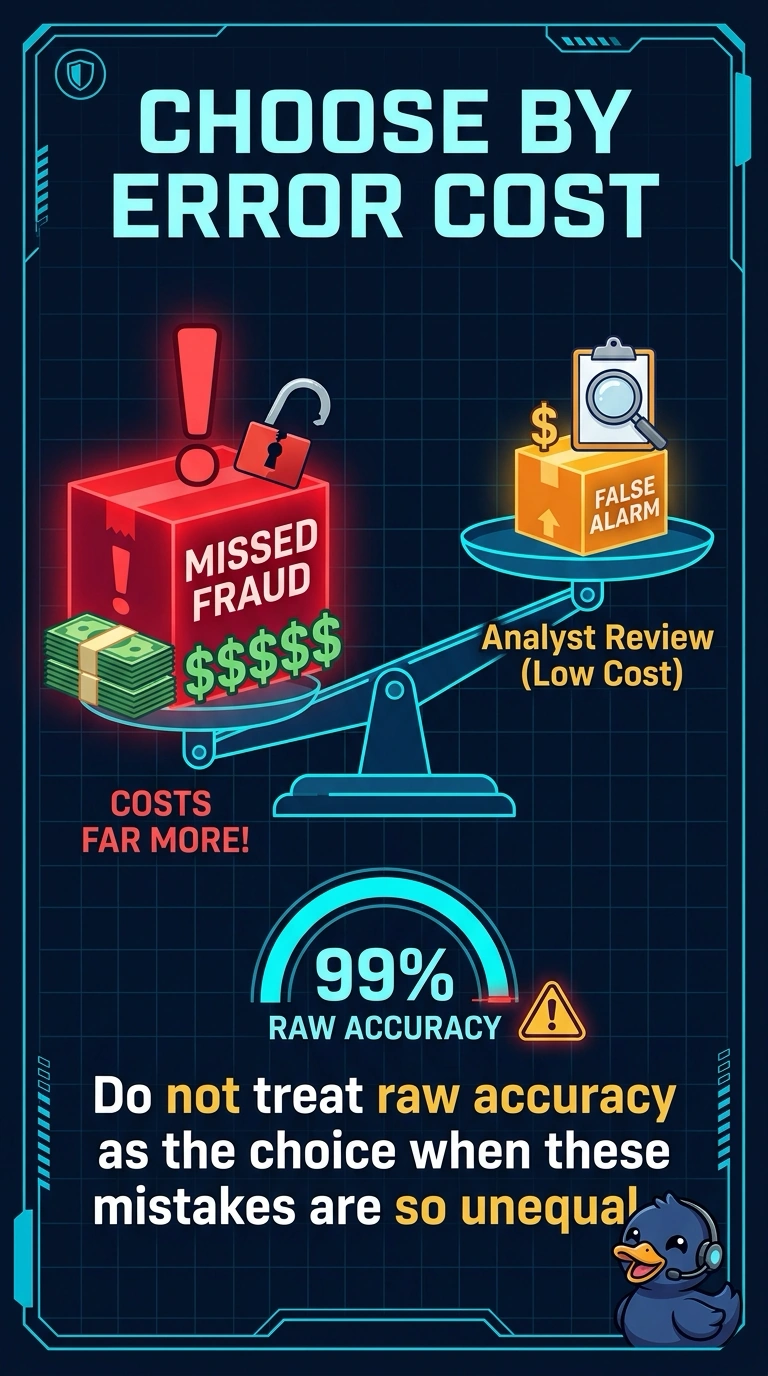
A quiet store can brag about a calm day while the expensive theft walks out. You have to weigh the cost of a missed fraud against the cost of a false alarm. The trap is letting a high accuracy figure hide two mistakes that do not cost the same.
Full Explanation
Accuracy counts correct calls over all transactions. When legitimate transactions dominate, a model can score well while still missing the rare frauds that cost the bank far more than an analyst's review of a false alarm. The choice should price those two errors separately and prefer the model whose mix of misses and alarms has the lower expected cost, not the model with the prettier accuracy. Highest accuracy hides that imbalance inside one rate and can crown a model that almost never flags fraud. Flagging the most transactions drives misses down and ignores the review cost the stem says is real, so it is a one-sided rule. Fewest alerts does the opposite, protecting analyst time and treating a missed fraud as no worse than a false alarm, which contradicts the stated costs. Exam caveat: accuracy can still be reported beside the cost; it cannot be the sole selection rule when the two errors are unequal. Operational check: confirm the selection sheet has a cost for a miss and a cost for a false alarm, and that the chosen model is the one with the better total cost.