
A hospital model of unplanned readmission matches the training charts closely, yet on new visits it loses to a rule that predicts the ward's historical readmission rate. What must a candidate show before it is recommended?
Select an answer to reveal the explanation.
Short Explanation
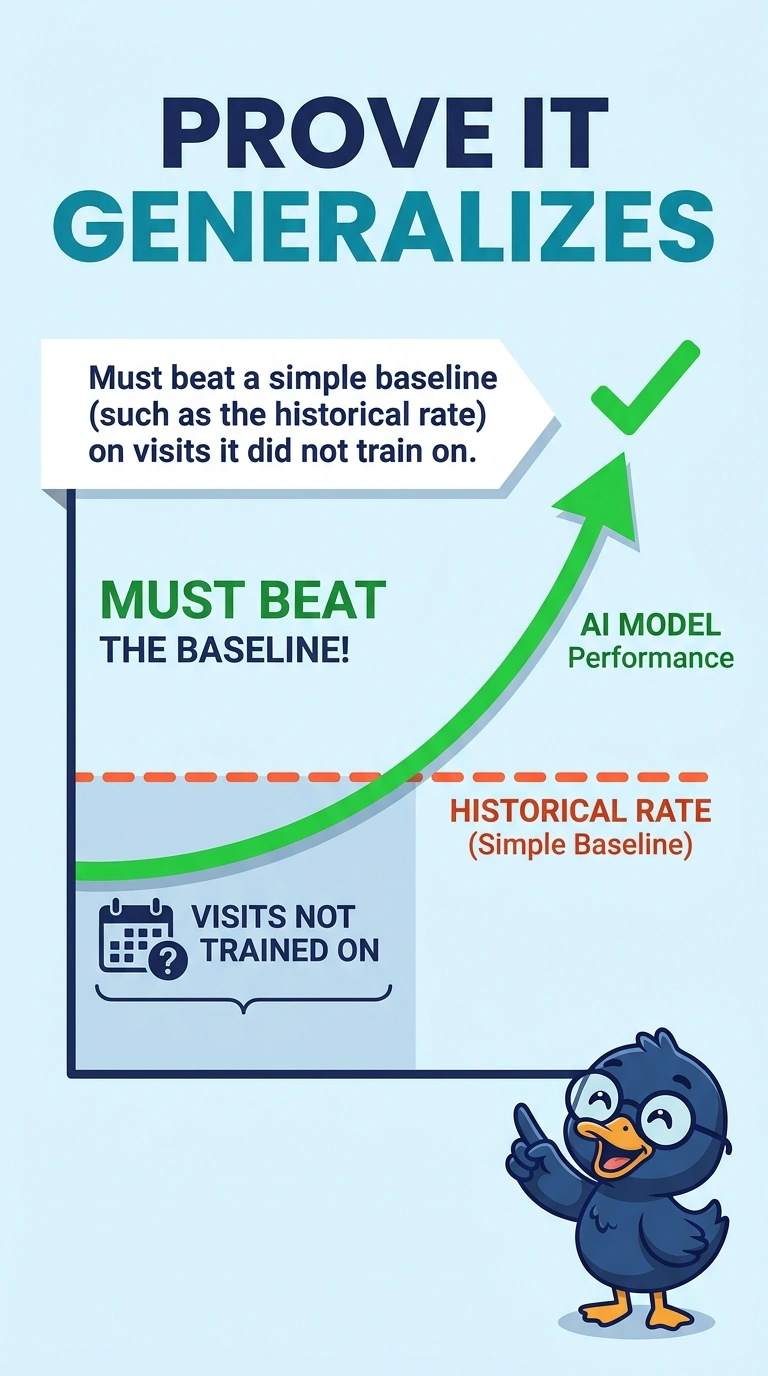
A new route has to beat walking, not just look tidy on the map you used to draw it. Your readmission model must beat the historical-rate rule on visits it did not train on. A close fit to the training charts is the trap.
Full Explanation
A simple baseline is a transparent rule, here the ward's historical readmission rate, that any candidate has to beat on data it was not fit to. Matching the training charts shows that the model can reproduce rows it has already seen, which a flexible model can do without learning anything that transfers. The stem already shows the failure: on new visits the historical-rate rule wins, so a training fit is not evidence the candidate is worth recommending. Clinician comfort with the variable list is a separate review of whether the inputs make sense, and it does not overturn a loss to the baseline on new visits. Beating a more complicated model fit on the same charts can hide a weak idea inside a contest of two overfit models; the required comparison is against the simple rule, on visits held out of training. Exam caveat: the baseline has to be a real simple alternative computed the same way on the same new visits, not a straw man scored on the training rows. Operational check: score the historical-rate rule and the candidate on the same new visits and withhold a recommendation when the rule still wins.