
A bank has searched learning rate, penalty strength, and class weight inside one logistic-regression family for loan-default risk. The features are already limited to what the credit policy can supply, and the held-out metric has stopped moving. What is the sensible next design step?
Select an answer to reveal the explanation.
Short Explanation
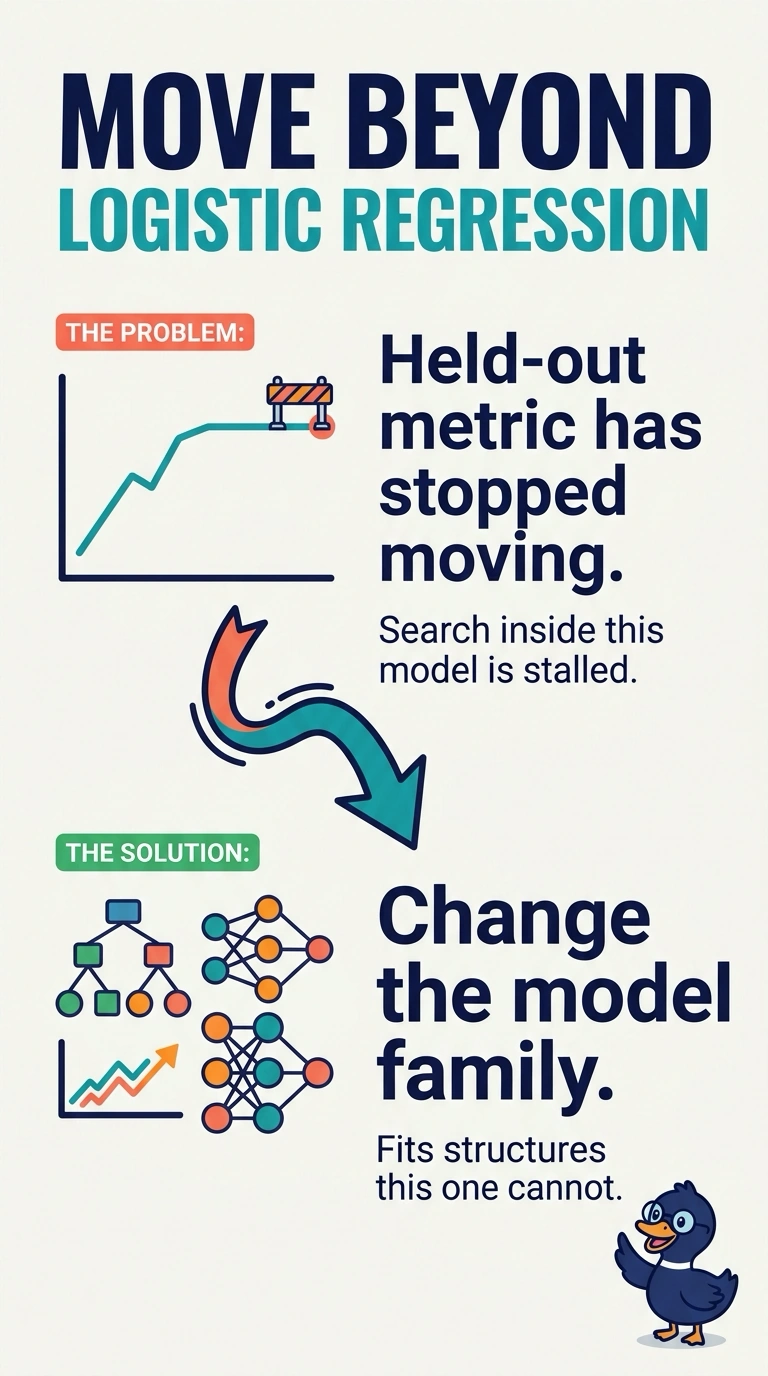
You’ve already adjusted the logistic model’s settings, and the held-out metric still will not move. Since the features you can use are set, the sensible next step is to try a different model family that may capture structure logistic regression cannot. A finer grid, new random seeds, or choosing by training performance would not address that limitation.
Full Explanation
Tuning learning rate, penalty strength, and class weight explores settings within the logistic-regression family. Those settings have been searched, the credit policy already limits which features you can use, and the held-out metric has stopped improving. Together, this suggests that the logistic model’s form—not simply an undiscovered penalty value—may be limiting performance. The sensible next design step is to try a different model family, which may represent structure that a linear log-odds model cannot. Searching a finer grid remains within logistic regression and spends more effort on settings after the held-out results have stalled. Changing only random seeds does not give the model a different form, so it cannot address that limitation. Choosing the training-set winner discards the held-out evidence and still keeps the search within logistic regression. Exam caveat: a different family is justified here because the policy has already fixed the available features; if richer features were permitted, changing the feature set would be an earlier design step. Practical check: record the searched ranges and flat held-out curve, then name the next model family in the design log before launching another logistic grid.