
A telecom team retrains a churn model several times a week. Last month's best run cannot be rebuilt because nobody recorded which extract, which code commit, or which parameter set produced it. What should each run record so that result can be rebuilt?
Select an answer to reveal the explanation.
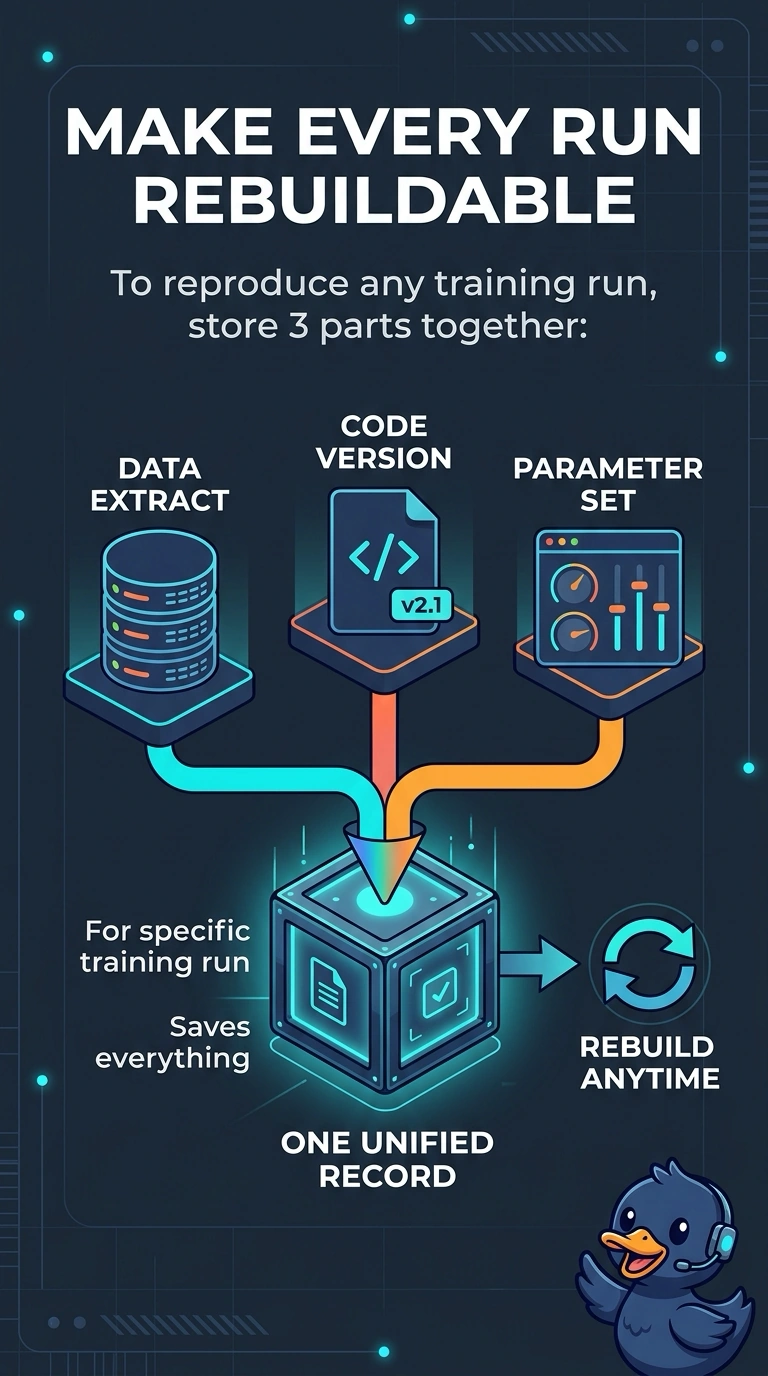
Short Explanation
A result you cannot rerun is a scoreboard with the plays erased. To rebuild last month’s champion, you need the data extract, code version, and parameter set stored together for that specific run—your recipe for reproducing it. An accuracy figure, an overwriting notebook, or fitted weights alone cannot put the run back together.
Full Explanation
Rebuilding a training run requires the inputs that defined it. The data extract identifies which rows were used, the code version identifies which transformations and model definition ran, and the parameter set records how that run was configured. Store all three together in a record tied to that specific training run, so you can reproduce the result later. A final accuracy figure is an outcome, not a recipe; it cannot recreate the extract, code commit, or parameters. A shared notebook that overwrites earlier parameter sets preserves only the latest state, losing the settings for the run that performed best last month. Fitted weights are the product of training, but without the extract and code commit they do not document how to repeat that training. The parameter record should include settings that affect the fit, not merely the model family’s name. Exam caveat: weights may let you score new rows, but scoring is not the same as rebuilding the training run that produced them. Practical check: select last month’s best run, verify that its record contains the extract identifier, code commit, and parameter set, then use those recorded items to rebuild it.