
A utility's new outage-duration model beats a flat historical average, but the control room's existing dispatch rules still produce shorter outages on the same recent cases. What should a recommendation require?
Select an answer to reveal the explanation.
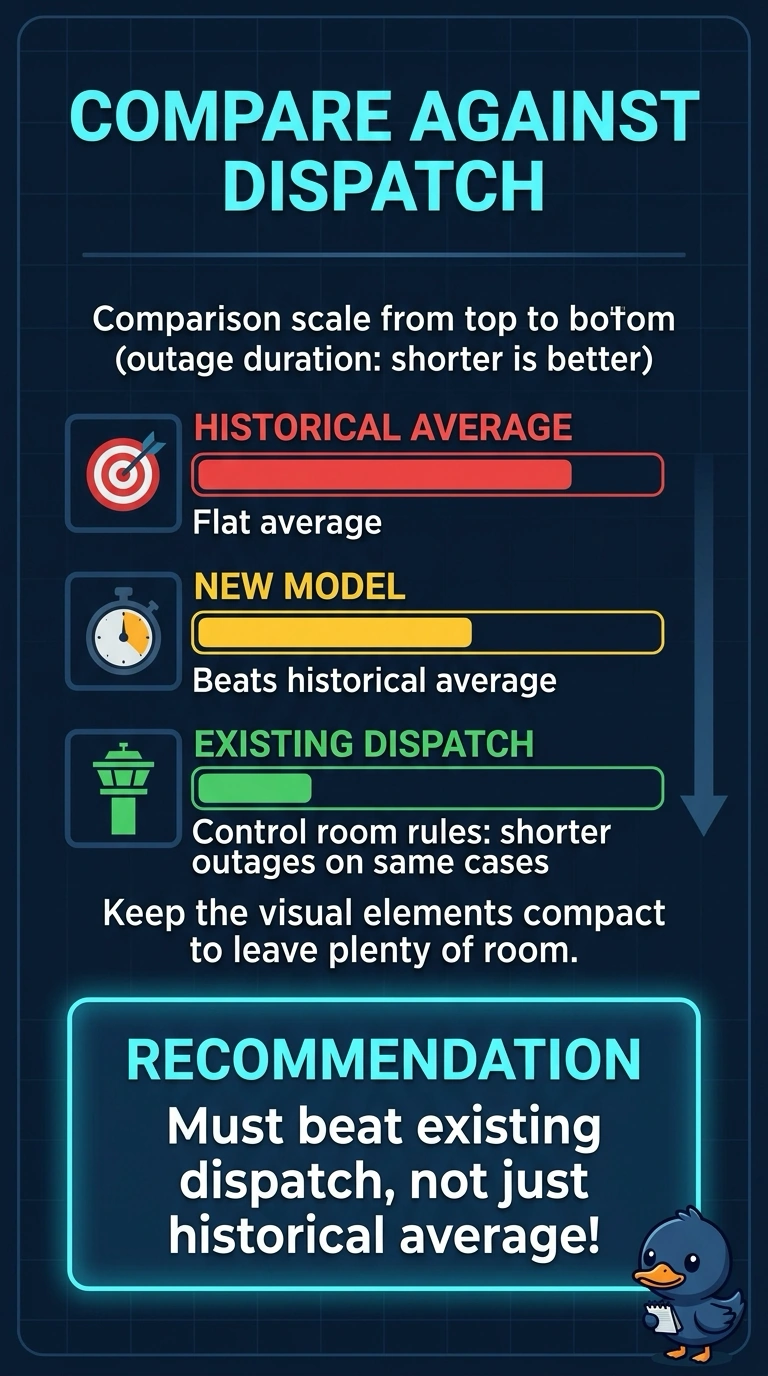
Short Explanation
A shortcut that only beats wandering in a field still has to beat the road your crews already drive. This model must beat the control room's current dispatch rules, not only a flat average. The average was a warm-up, and the trap is stopping there.
Full Explanation
A recommendation to change operations has to beat the process those operations already use. The new model wins against a flat historical average and still loses to the control room's dispatch rules on the same recent cases, so the incumbent process remains the better outage-duration result. Treating the average as the decisive comparison promotes a model that is worse than the rules the utility would be replacing. A close fit to last year's outages repeats the training-fit mistake and ignores the recent comparison the stem already reports. Shipping the model because it is newer skips the duration comparison entirely. The flat average ignores how the control room already assigns crews and priority. Beating it only shows a win over a naive number, not over the process a recommendation would actually replace. Exam caveat: a simple average is a useful floor, and clearing that floor is not a reason to retire a live process that still wins on the cases that matter. Operational check: on the same recent cases, compare outage duration under the current rules with duration under the candidate, and recommend the candidate only when it produces the shorter outages.