
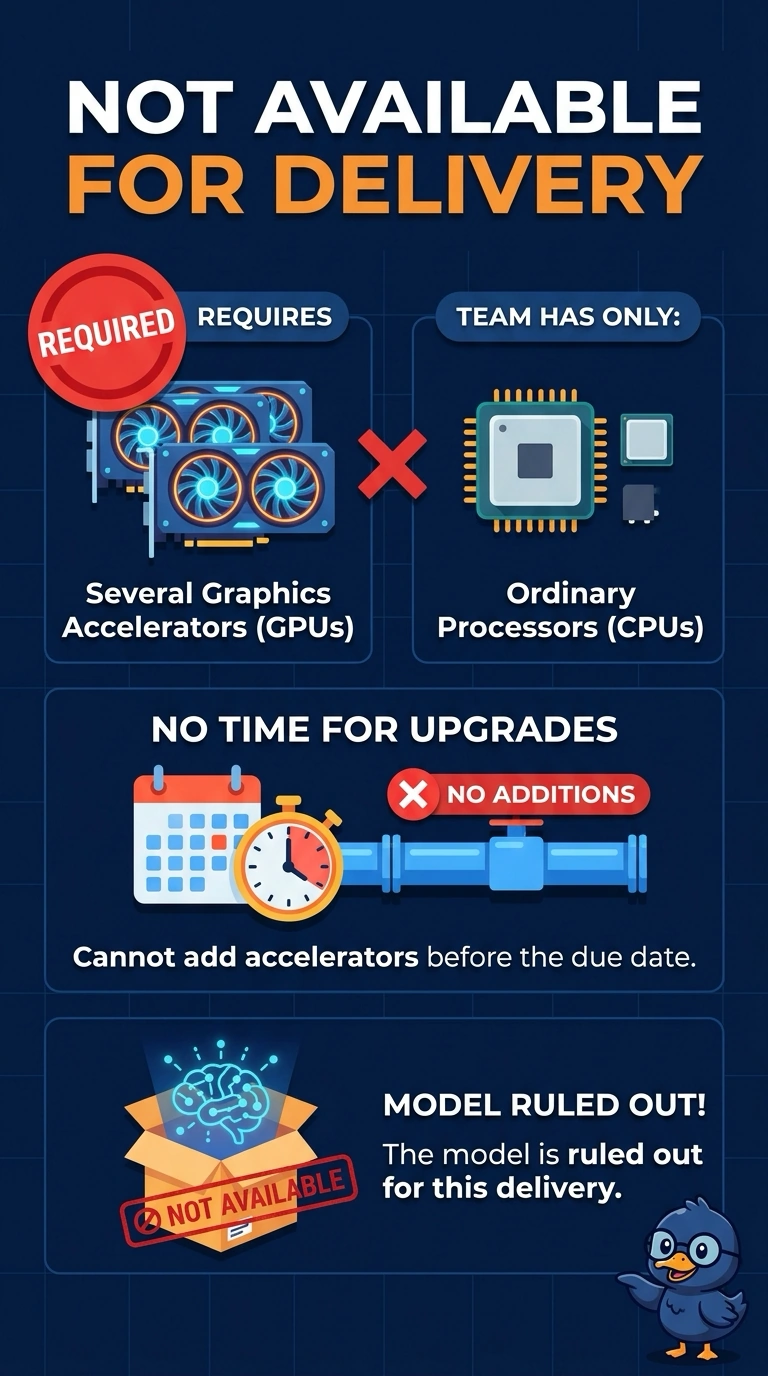
A public agency wants a vision model that the write-up says needs several graphics accelerators. The agency has only ordinary processors and cannot add accelerators before the work is due. Which conclusion follows for this delivery?
Select an answer to reveal the explanation.
Short Explanation
You cannot cook a meal that needs an oven you do not have. A model that requires graphics accelerators is out for this delivery when the agency has only ordinary processors. A strong write-up does not install the missing hardware.
Full Explanation
Available hardware is a feasibility screen. A model specified to need graphics accelerators cannot be the delivery choice when the agency has only ordinary processors and cannot add accelerators in time. The conclusion is to rule that model out for this delivery. Treating ordinary processors as if they matched the quoted accelerator runtime keeps a plan the hardware cannot support. A strong published accuracy does not remove the constraint, because a result the team cannot train is not a result they can deliver. Shrinking the images and still claiming the write-up's accuracy changes the problem while pretending the evidence still applies. Hardware is screened the way a deadline is screened: if the required machines are not there, the candidate is not deliverable, however strong the write-up looks. Ordinary processors can still train some other model; they do not silently become the accelerators this write-up assumed. Exam caveat: a different architecture that fits on the processors is a new candidate and must be judged on its own results. Operational check: compare the model's stated accelerator requirement with the servers on hand and reject the model when those accelerators are absent.