
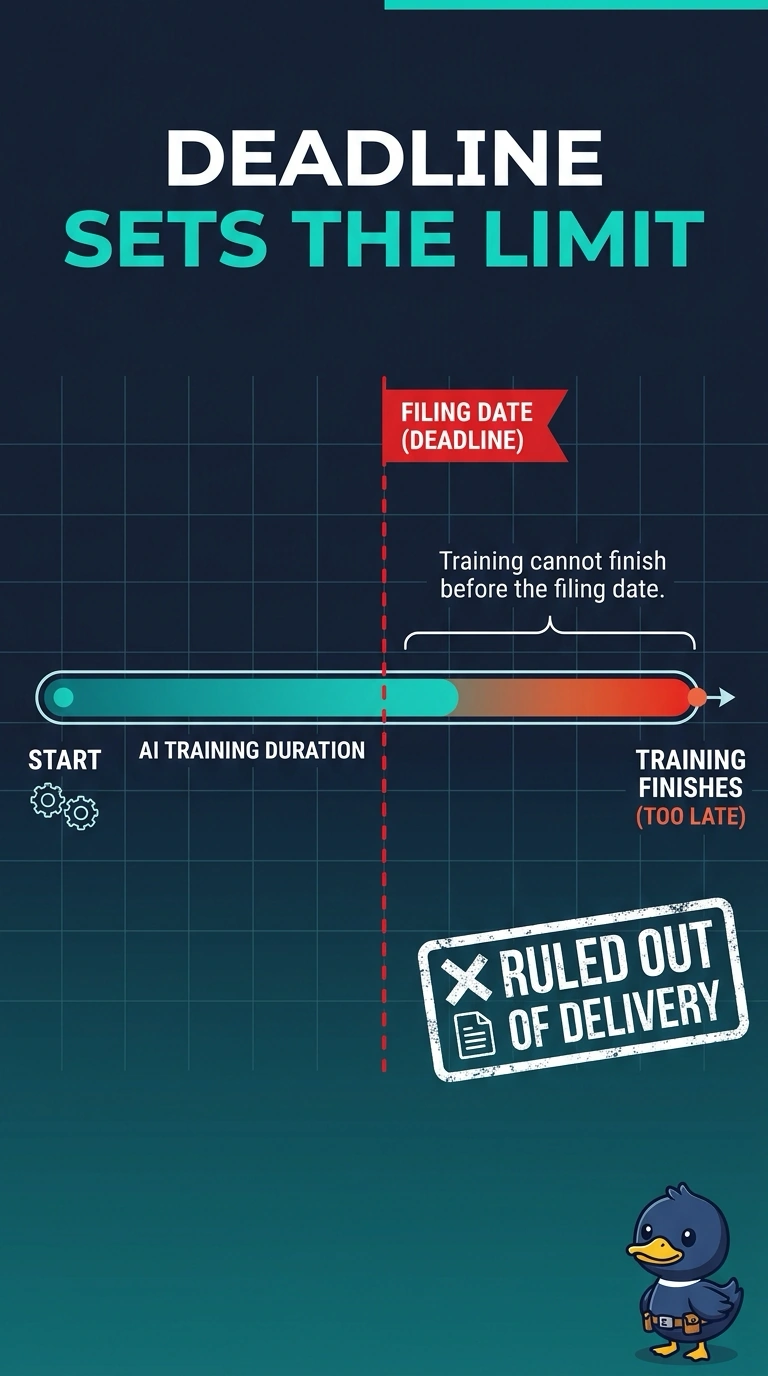
A bank must deliver a fraud model before a fixed regulatory filing date. One candidate looks slightly stronger in a published write-up, but training cannot finish before that date. Which conclusion follows for this delivery?
Select an answer to reveal the explanation.
Short Explanation
You can treat the filing date as a hard constraint, not a suggestion. If training cannot finish in time, that model cannot be used for this delivery, even if its published write-up looks slightly stronger. Keep the date in view when deciding what can actually be filed.
Full Explanation
The deadline rules out the candidate for this delivery because training cannot finish before the fixed filing date. A published result, even one that looks slightly stronger, does not make a model feasible to train and deliver on this bank’s schedule. Keeping the candidate because published accuracy outweighs the calendar confuses reported performance with the ability to meet the required date. Treating training time as only a hardware detail misses the binding issue: whatever the cause, training will not finish in time for this filing. Keeping the most elaborate candidate and accepting a missed date likewise puts complexity ahead of a fixed regulatory requirement. The relevant comparison is not simply which candidate looks strongest, but which can be completed by the deadline. Exam caveat: a stronger published result does not establish that the same result is achievable within this delivery’s schedule. Practical check: compare the estimated training completion time with the filing date and rule out the candidate if training would finish after it.