
A hospital can spend only a fixed amount to train a readmission model. A second model is slightly more accurate, and its training bill exceeds that cap. Which conclusion follows?
Select an answer to reveal the explanation.
Short Explanation
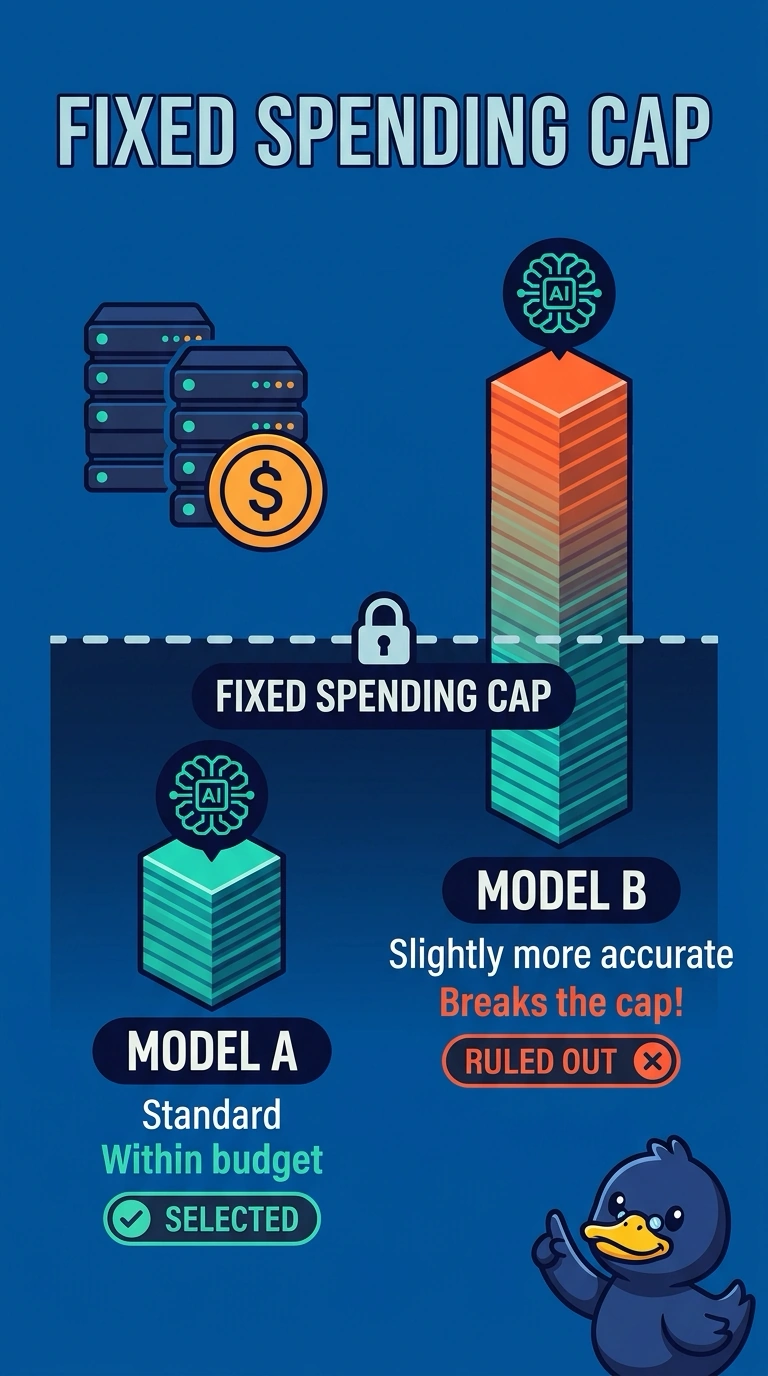
A budget is a fence you do not hop just because the view is slightly better on the other side. You reject the costlier model when its training bill breaks the cap. A small accuracy edge does not erase the overrun.
Full Explanation
A spending cap is a hard constraint on model choice. The slightly more accurate model costs more than the hospital can spend, so it is ruled out for this project even though its accuracy is a bit higher. Dropping the cap because any gain is worth an overrun simply cancels the constraint the team was given. Reporting that model's accuracy as if it had been trained inside the cap claims a result the budget cannot buy. Averaging the two accuracies while paying only for the cheaper run mixes a model the project did not train into a result it did not earn. The cap is about what this project can pay to train, not about which comparison looks better in the abstract. A slight accuracy edge can be real and still be irrelevant once the bill crosses the cap, because the hospital cannot buy that edge. Staying inside the cap means keeping a model the project can actually train and reporting that model's accuracy, not borrowing a number from a run the budget never bought. Exam caveat: a cheaper variant is a different candidate and does not inherit the costlier model's accuracy. Operational check: set the costlier model's training bill next to the cap and exclude the model when the bill is above the cap.