
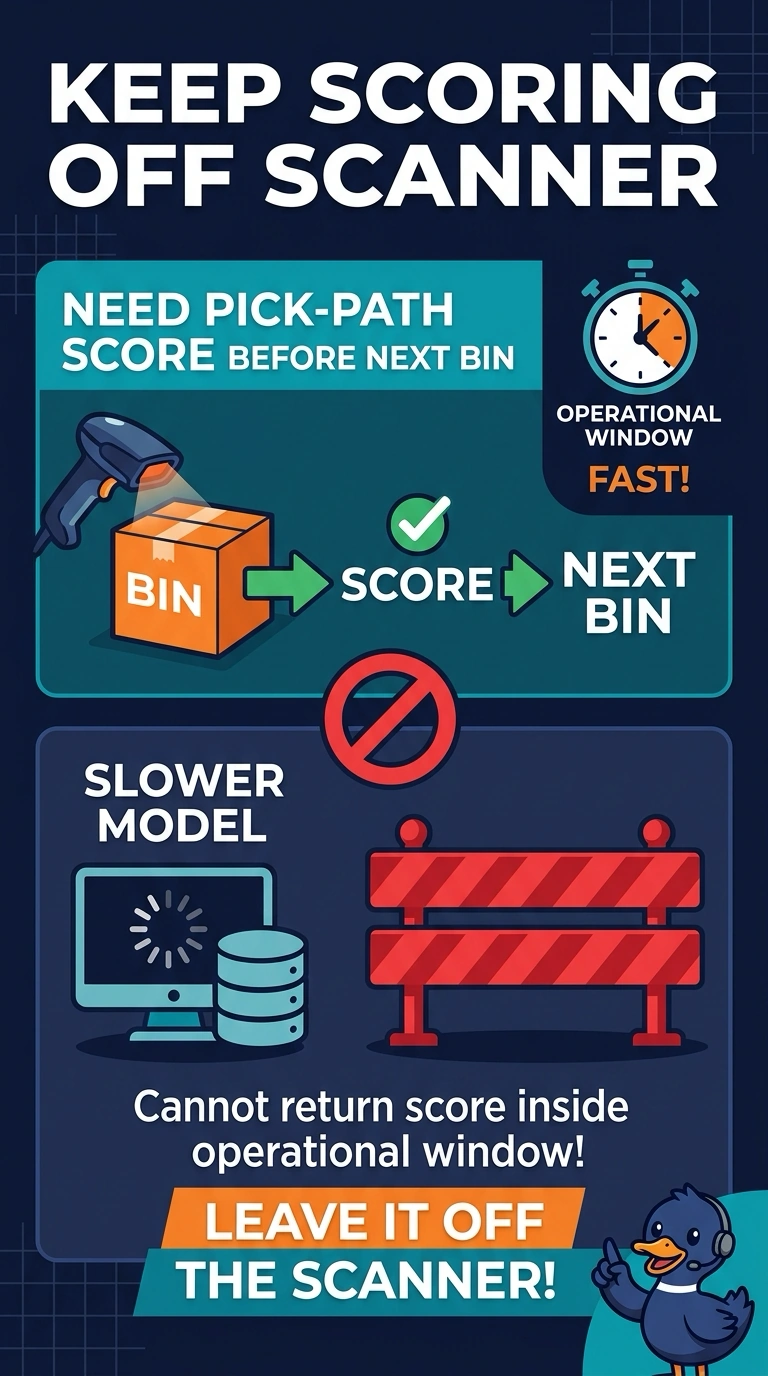
A warehouse scanner must receive a pick-path score before it moves to the next bin. One model is more accurate but cannot return an answer inside that window. Which conclusion follows for the scanner step?
Select an answer to reveal the explanation.
Short Explanation
A score that arrives after the scanner has moved is like an answer shouted after the train has left. You should leave this model off the scanner step because it cannot respond inside the operational window. Training that finished on time does not make a slow prediction fast.
Full Explanation
Inference latency is the time a model takes to return one score, and the scanner step has a hard operational window: the score must arrive before the scanner moves to the next bin. The more accurate model cannot meet that requirement, so you should leave it off this step. Using it anyway because a late score might still be useful to the picker does not satisfy the scanner’s need for a score in time to guide the move; once the scanner has moved, that score cannot steer the completed step. Training duration is a different measure from inference latency. Finishing training on schedule says nothing about whether a single prediction can be returned quickly enough, so that fact does not justify keeping the model on the scanner. Shortening the warehouse window also cannot make a slow model fast enough: it tightens the deadline rather than improving the model’s response time. Accuracy and timeliness are separate requirements, and this model fails the timeliness requirement for the scanner even if its score is more accurate. The relevant deadline is the move to the next bin, not the training schedule or a revised, shorter window. Exam caveat: the same model could still be useful for an overnight report where the scanner’s operational window does not apply, but that would not make it suitable for this scanner step. Practical check: time a single score under scanner-like load and keep the model off the step if it takes longer than the available window.